Category Archives: Mummers

The Rag Morris Mummers Picture Show

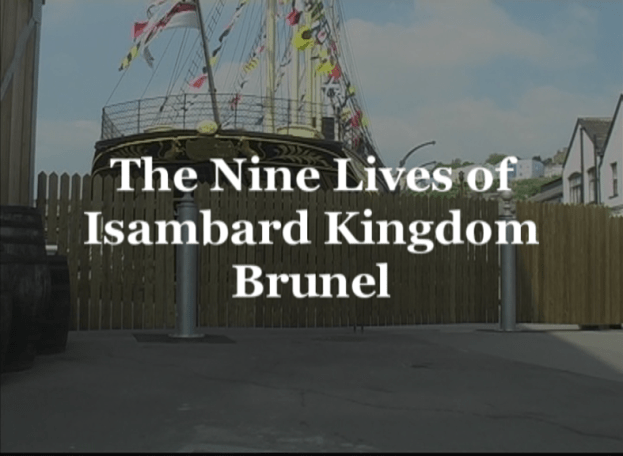
Rag Morris Mummers are currently in lock down and won’t be mumming for the foreseeable future, so to keep us all entertained during these days of isolation here’s a chance to see the full production of our mummers’ play, “The Nine Lives of Isambard Kingdom Brunel”.

This was a performance from 30th April 2011, filmed just outside the SS Great Britain, shortly before we took the play to the main stage of the Colston Hall for the inaugural Bristol Folk Festival.

We’ve just seen the anniversary of the birth of Marc Isambard Brunel on 25 April, and it’s a couple of weeks after Isambard Kingdom Brunel’s birthday on 9th April, so please consider this to be a fashionably late Birthday Present.

The Nineteen Lives

The play has been performed a number of times over the years since it was premiered in 2009.

The following list includes all public performances of the Brunel play, so far…

DateTimeLocationNotes
12 September 200910:00Zion Hill, near Clifton Suspension BridgeWorld Premiere!
Bristol Doors Open Day
Bristol Poetry Festival
12 September 200911:30Underfall YardAs above
12 September 200912:30SS Great BritainAs above
12 September 200914:30Queen SquareAs above
12 September 200915:30Temple Meads Passenger ShedAs above
15 September 200919:30Anchor Square, At-Bristol150th Anniversary of Brunel’s death
29 September 200921:00The Mansion House, Clifton Down, BristolPerformance for the Lord Mayor!
3 July 201020:00Great Western Morris 40th Anniversary, Christow.“2 Lives” cutdown version
30 April 201111:30SS Great BritainBristol Folk Festival warm-up
30 April 201112:30M-ShedAs above
30 April 201114:00Colston Hall, Main StageBristol Folk Festival
24 September 201121:00Woodhouse ParkRag Morris 30th Anniverary Weekend
17 November 201121:15Chapel Arts Centre, BathBath Mummers Unconvention
Mumming UnPlugged 
19 November 201110.30North Parade, Bath (Near the Huntsman pub)Bath Mummers Unconvention
19 November 201111.10Bath Abbey Churchyard (Near the West Door)As above
19 November 201114.00 Old Bond St, Bath  (North end)As above
8 July 201811:00Priddy Folk Festival, Eastwater MarqueeNine Lives – 9th anniversary revival
21 July 201812:00Brunel SquareBristol Harbour Festival
21 July 201814:00M-ShedAs above
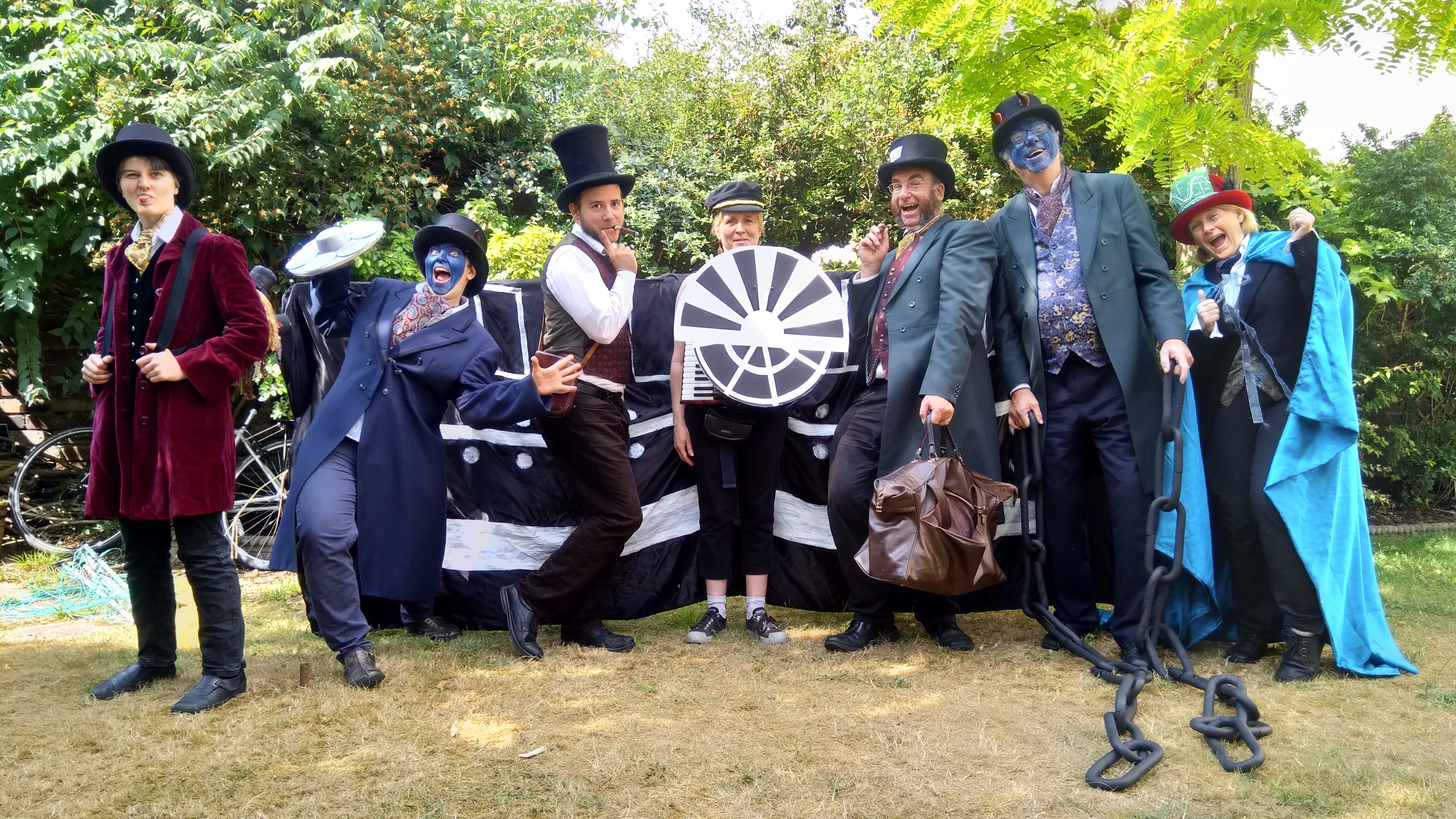
Rag Morris Mummers meet Wallambard after performing at Bristol Harbour Festival 2018

The tale I have to tell this day is of a hero bold

I didn’t mean to write a mummer’s play. They say you should write about what you know, and I didn’t know very much about mumming, not at first.

I’ve been a morris dancer for many years. Almost ten years ago, for a creative writing challenge, I started by writing a three act play about the rivalry between fictional morris dance sides.  The play would include various types of events that morris dance sides are often involved with. The middle act would be based around a mummer’s play that one of the morris sides would perform. As the story was set in Bristol, I decided that the mummers play would be about a local hero and my first choice was the civil engineer, Isambard Kingdom Brunel.

By the time I’d finished writing the middle act, it was obvious that this was the part of the story that I’d expended all my energy on and the rest was quickly forgotten. The mummers play would take on a life of its own, not least because I was a long standing member of Rag Morris, a non-fictional morris dance side who would prove to be interested in performing that mummers play in its entirety.

When I first started,  the only mummers play script I had a copy of was the last original mummers play that Rag Morris had staged in public. This was the story of Vincent and Goram, two legendary giants who were said to have carved out the Avon Gorge, a spectacular river valley next to the City of Bristol. That play was composed by local artist, author and former Rag Morris dancer Marc Vyvyan-Jones, with help from Roland and Linda Clare. Because that play was fairly loosely based on mumming play conventions, I figured that I would write my play to tell its own story with characters based on mumming archetypes and some of the structure from a mummers play, but to use the characters as storytellers to relate a series of incidents from Brunel’s biography, with bad puns, rhyming couplets and dramatic reconstructions.

The Vincent and Goram play begins with an introduction by Old Father Thyme; so I started my play by converting this speech into an introduction by Old Father Thames, a traditional folkloric representation of the English river in human form.

OLD FATHER THAMES

In comes I, Old Father Thames,
Welcome or Welcome Not
I hope Old Father Thames
Will never be forgot.

I rise in the west and flow to the east
Towards the rising sun
I began my journey before you were born
I’ll be going when you are long gone

The tale I have to tell this day
Is of a hero bold
A Great Briton they have called him
Though his story’s not that old

So come with me a century
Or two into the past
For now it’s time to step aside
And introduce the cast


In 2002 the BBC ran a poll, encouraging people to vote for the person they considered to be the Greatest Briton; and Isambard Kingdom Brunel came second, after Sir Winston Churchill.

The extraordinary life of I.K.Brunel lent itself admirably to a reinterpretation in the form of a mummers play. I started writing the play a couple of years after the celebration of Brunel’s 200th birthday in 2006; an anniversary that was marked with a series of events in Bristol. An exhibition entitled “The Nine Lives of I.K.Brunel” hosted in Bristol next to his great ship, the SS Great Britain, provided both the title and structure of the play. I began to read biographies, diaries and articles about the engineer to find out as much as I could about the story and and the subjects I wanted to portray.

All the incidents described in the play are based on historical fact; with a story as rich as this, full of ambition and success, comedy, tragedy and some frankly ridiculous accidents, there was no need to make any of it up. The award-winning Horrible Histories TV series, based on a series of books, uses the same process of sticking as closely as possible to the historical truth to draw out the humour of the situations. The first series was broadcast in 2009, the same year that the Brunel Play made its debut. I don’t believe that Horrible Histories have done a full episode on Brunel yet but I’d be open to offers if they want to use any of my rhymes.

Our hero introduces himself with a straightforward couple of verses

BRUNEL

In comes I, I’m Isambard –
Isambard Kingdom Brunel
An Engineer I am by trade
With many a tale to tell

I’ll build the biggest ships
and I’ll design the fastest trains
But mostly I’ll be famous for
Smoking by giant chains.

A famous photograph of Brunel, by Robert Howlett, shows him standing next to the drums which held the chains used for launching his monumental ship, the SS Great Eastern; hands in pockets, puffing on a cigar. It’s the most iconic photographic portrait of the Victorian era, and so I was keen to get in a reference to that image early on in the play.
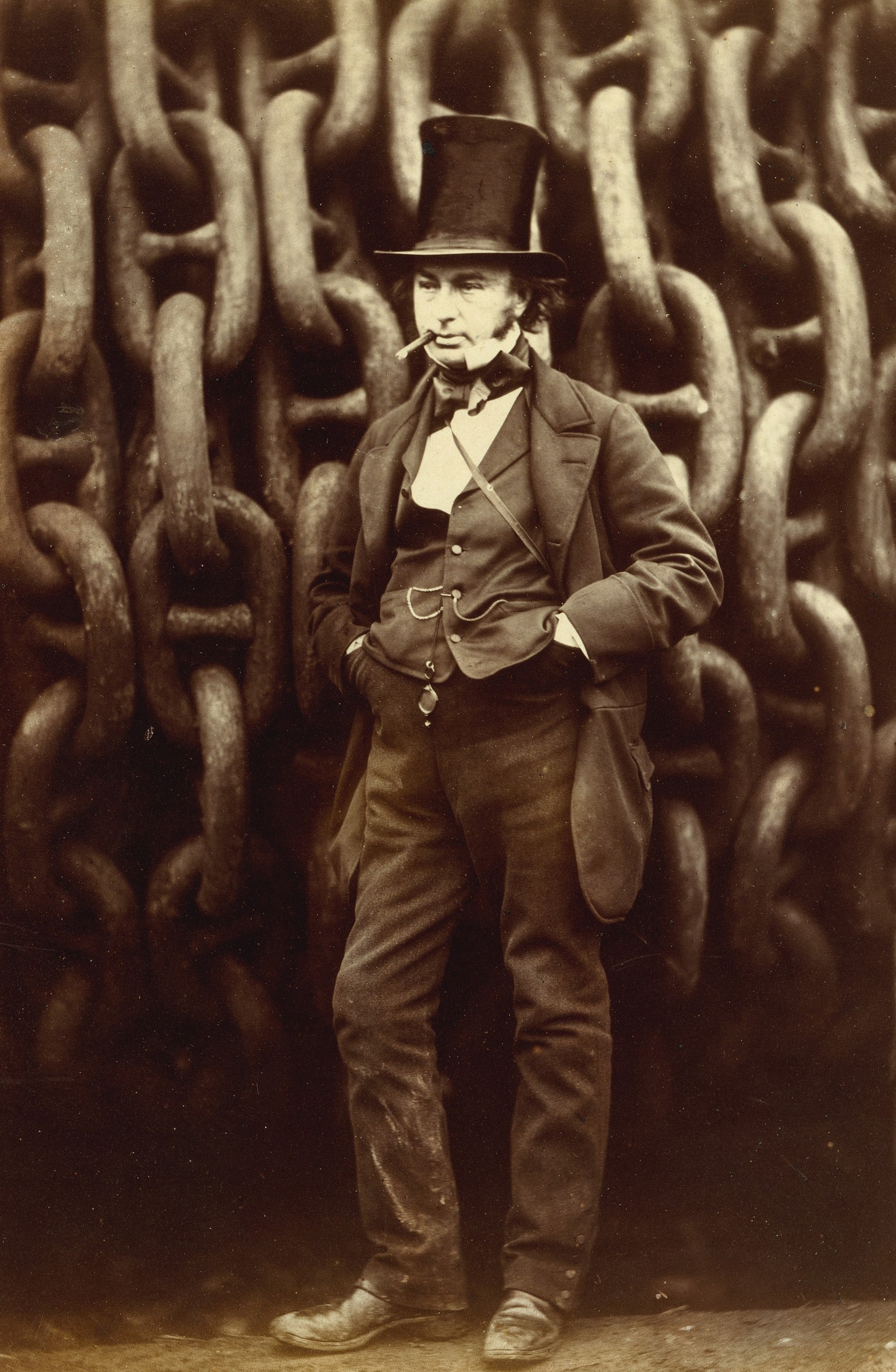
Isambard Kingdom Brunel Standing Before the Launching Chains of the Great Eastern, photograph by Robert Howlett.

Isambard Kingdom Brunel Standing Before the Launching Chains of the Great Eastern, photograph by Robert Howlett.

The other characters introduce themselves. Doctor Foster, down from Gloucester, is a traditional mummers play character who will help revive our hero after his numerous accidents, representing the many physicians who did so in real life.

For one example, in his later years, Brunel’s  doctor was his brother-in-law and friend Seth Thompson. He was the doctor who first helped Brunel when a half-sovereign accidentally dropped into one of his lungs while performing a magic trick. He also accompanied Brunel and his family on a recuperative trip to Egypt during the last year of his life, and was an executor and beneficiary of Brunel’s will.

The Vincent and Goram play features a character called Brunel-zebub as the traditional diabolical panhandler at the end of the play. St Vincent’s rocks on the Avon Gorge was eventually the site of Brunel’s Clifton Suspension Bridge, Brunel’s first great undertaking, eventually completed as a memorial to him to become an icon for the City of Bristol. In my play Brunelzebub is the villain of the piece, whose ambition is to thwart Brunel’s plans and remind him of the rising death toll that accompanied his ambitious projects. He forms a double act along with Bold Slasher to represent Brunel’s inner demons or ‘Blue Devils’ that he described in his diary during his periods of self-doubt.

Then in comes Little Johnny Jack, with his family on his back. In our play, this character, along with Old Father Thames, provide the exposition, helping to set the scene for each of the nine episodes.
IMG_20180721_110138

With these characters in place I then began to translate each of the stories into verse and rhyme, each of the episodes lasting couple of minutes at most. I was constrained by the facts that I wanted to fit in to each segment; I wrote at the top of the script, “Abridged by Gavin Skinner”, as it felt like I was creating a rhyming summary of an existing story; and in Bristol, Brunel himself was well known building a bridge.

At the time I was writing the play, my eldest was three years of age, so I was reading a lot of children’s story books. Writers who specialise in this field such as Dr Seuss, Julia Donaldson and Lynley Dodd have probably written more poetry that is actually read out loud than anyone else, and I’m sure my familiarity with their work at that time made it easier to pick and choose rhymes and rhythms.

Here are a few examples of some of my favourite lines from the play, with an explanation of some of the source material and ideas which went into the composition.

I was keen to write a bridging verse between each of the stories and was looking for a connection between the elegant Queen Square, where Brunel fought as a special constable as it was ruined during Bristol’s riots in 1831, and the story of his Great Western Railway. I found my answer in a magazine article that referred to a little-known fact from Brunel’s diary; at one time he considered siting his railway terminus in the square.

BRUNEL

This riotous conflagration’s left Queen Square in devastation
Making it a prime location for the station Bristol needs
But should the City’s Corporation recommend its restoration
I’ll build my station by the Avon in a field called Temple Meads

After an episode in which Brunel fails to listen to expert advice during the delivery of a railway locomotive, it’s up to Little Johnny Jack to link to the next topic.

JOHNNY JACK

The Great Western Railway became a success
But what to do next made Brunel rather frantic
He wanted the journey to go further west
By Great Western Steamship across the Atlantic

BRUNEL

The problem is this – there are those who insist
That an Atlantic steamship just cannot exist
That a big enough hull would require so much coal
You would always run out before reaching your goal

But I’ve done some sums that just prove that they’re wrong
And that nautically I’m engineer number one
My ship will go fast and will be built to last
And have room for the passengers too – that’s first class

Johnny Jack links neatly from one story to the next. Brunel’s speech, with a slightly different rhyming structure, is meant to reflect the rhythm of the steam engines that drive the ship. An earlier version of the speech included a rhyme with “boat” and “float”, but I was told unequivocally  by a representative of the SS Great Britain that Brunel built ships not boats.

The verses allude to the long-running dispute between Brunel and Victorian author and science communicator Professor Dionysius Lardner, who insisted that as a ship’s size increased, so would its requirement to store coal; meaning that no ship could be big enough to travel by steam over the Atlantic. Brunel proved that the fuel carrying capacity of a ship is related to the cube of its size whereas the drag of the hull, which dictated the power required to drive the ship, is in proportion to the square of its size; which meant it was perfectly possible for his large steamship to cross from Bristol to New York with coal to spare.

The story of the Battle of Mickleton Tunnel is one of the most astonishing and yet little-known episodes in Brunel’s industrious career. The contractors hired to dig a railway tunnel in Gloucestershire believed they were owed money by the railway company and downed tools and prevented the railway company from accessing the tunnel. In an utter breakdown of employment relations, Brunel raised an army of three thousand navvies from other projects in order to take back control, by force.

OLD FATHER THAMES

The fighting began, several heads and limbs broken,
Some shoulders popped out and one skull cleft in two
with a shovel; but no-one killed outright, so that’s alright,
and victory to the company in the morning dew!

The contractors found that resistance was futile
And the contract redrawn over cups of hot tea
Brunel’s private army the last to have fought
A pitched battle on the soil of our fair country

The description of the fight was almost word for word from one of the accounts of the battle.

The last of the Nine Lives, and the final character to appear, concerns Old Leviathan, the nickname for the Great Eastern, the largest ship ever built when she was launched in 1858; a record that would be held until she was broken up just over 30 years later.

OLD LEVIATHAN

In comes I, old Leviathan
Brunel’s greatest project
And his last
They said that I killed him
I almost quite ruined him
The world’s finest ship
I’ve come back from the past

So why did he build such a monstrous Leviathan?
To travel non-stop to Australia by steam!
No ship will surpass me for half a man’s lifetime
There’s no power on Earth that can compare with me

The last line was inspired by the cover image from Thomas Hobbes’ book, “Leviathan”, that I spotted in a newspaper while writing the play. This includes the inscription, “Non est potestas Super Terram quae Comperatur ei”, itself a biblical quote from Job chapter 41: “There is no power on earth to be compared to him”

But the stress of building the monstrous ship was too much, even for Brunel; he visited his marvellous ship for the last time shortly before her maiden voyage, when he suffered a stroke.

In our play, this represents the final victory for the blue devil Brunelzebub, who in a final act of indignity, recounts Brunel’s last days in the form of a limerick; albeit one with a deliberate break in the rhythm or scansion in the second line.

BRUNELZEBUB

As Brunel he went home and was lying on
His deathbed…
…his steamship was flying on
Then some pipes overloaded,
A boiler exploded
And six stokers were dying on Leviath-on

Brunel built his great reputation
On the work of the men of this nation
Only some paid the price
Of their own sacrifice
What they need is a standing ovation

This character represents the engineer’s inner demon, and it seemed appropriate to give voice to his own regrets and self doubt at this point. Brunel’s son Isambard wrote of his father in his biography, “The Life of Isambard Kingdom Brunel, Civil Engineer”,

In times of difficulty, such as the trial of the Atmospheric System and the launch of the ‘Great Eastern’, his chief thoughts were for those who would suffer through the failure of his plans.

Each of the characters then stands to give their own tribute to Brunel, or in the case of Bold Slasher, something based on a less than flattering obituary:

Not one of the great schemes which he set on foot can fairly be called profitable, and yet they are cited, not only with pride, but with satisfaction, by the great body of a nation supposed to be pre-eminently fond of profit; and the man himself was, above all other projectors, a favourite with those very shareholders whose pockets he so unceasingly continued to empty.

There is always something not displeasing to the British temperament in a magnificent disappointment.

Obituary in the Morning Chronicle 1859

This translated into rhyme like this:

BOLD SLASHER

This ambitious, reckless engineer
Financially so cavalier
His work cost his investors dear
As profits tumbled year on year
Which they accepted with good cheer
Good grace and no resentment

His shareholders would never fear
For he would always “pioneer”
With bold abandon persevere
It only boosted his career
The British temperament finds good cheer
In a magnificent disappointment

Finally, in a change from the traditional mummers play role, Doctor Foster has to admit defeat, and he can’t bring this hero back to life.

DOCTOR FOSTER

Here I stand, Old Doctor Foster
And I know what I can, and what I cannot do
This man has done more in his short life than I ever could
But even I know when a man’s life is through

Here lies a man who learned how to move mountains
And we must remember his story to tell
For his legacy’s still all around us – no doubting
The greatness of Isambard Kingdom Brunel.

I imagined the first line of the last verse as a bookend to the line from Dr Seuss’s final book; Oh, The Places You’ll Go!

“Kid, you’ll move mountains!
Today is your day!
Your mountain is waiting.
So get on your way!”

And we finish with a reminder that we are all just storytellers, telling the tale of a hero, bold, as Old Father Thames said in his introduction. The Doctor’s last line is only the second time that Brunel’s full name is used in the whole play, after the title character introduces himself at the start.

But in the end, in our play, Brunel Lives! He leaps to his feet without any Tip-Tap or Hocum Pocum and leads a final heroic Morris Dance as the crew of the SS Great Eastern finally set sail for South Australia.


And so the play arrived through a series of serendipitous coincidences, of story and history, time and place, form and structure, rhyme and rhythm.  In its own way it became a success, from the original performances of Nine Lives in 2009, nine years ago today; three days later to mark the 150th anniversary of the death of Brunel, and through several revivals. There are a number of relevant performance locations linked to the stories we tell and we have taken our play to all the most resonant sites in Bristol. There are also an ongoing sequence of significant anniversaries of events in IKB’s life and career. This summer we performed the play during Bristol Harbour Festival on stage in Brunel Square, next to the SS Great Britain, two days after the 175th anniversary of the launching of this great ship.

The writing of it only deepened my respect and enthusiasm for the great man. But it has left me with something of a problem.  I had hoped that I would develop a series of mummers play biographies, but the truth is that there isn’t anyone else quite like Isambard Kingdom Brunel. In the nine years since I still haven’t found any other life story more worthy of re-imagining as a mummers play.

After writing this play, I started more properly investigating the form and structure of traditional mummers plays on websites such as Master Mummers, an excellent research resource which include a wealth of information and links to hundreds of traditional scripts. The other plays we’ve done have tended to be more closely aligned with the source material, respecting it to a greater or lesser extent as required.

Going forward, it must be time to start thinking of writing another play, on a completely different topic, perhaps one that has fewer ties to the mumming play format and yet allows more freedom to create original rhymes and characters and stories. Perhaps I’ll write it, or perhaps you will. I look forward to reading it or seeing it or being in it. Mummers plays are a living tradition. Just give us room to rhyme!

En Avant!


With thanks to Greg Brownderville, Director of Creative Writing and Associate Professor of English at Southern Methodist University, who kindly asked me to speak with his students this evening over the interweb about the writing of mummers plays. Good luck to his students, and anyone else, who might be inspired to write one! 

I read most of the above post by way of an introduction. 


Photograph of Brunel By Robert Howlett (British, 1831–1858) (Metropolitan Museum of Art) [Public domain], via Wikimedia Commons.

Photographs of the 2018 cast taken by Patrick Slade.

All extracts of the script copyright © Gavin Skinner. 


Nine lives, five years on

Five years ago, in September 2009, Rag Morris Mummers first performed a mummers play about the life of Isambard Kingdom Brunel. Two years later we took the play to the first Bath Mummers Unconvention, and I presented a talk about the play at the Mummers Symposium; the text from the talk is available in the Symposium Proceedings on the Folk Play research web site. Now that it’s five years since we started rehearsing our play,  I thought it was time to add a version of that talk on my preinclusion blog, and at the same time include some video excerpts of our first performances.

Brunel Play Wordle
You may have been lucky enough to see the play in Bristol in 2009, or at the 2011 Bristol Folk Festival where it was performed on stage at the Colston Hall. The play was performed at the 2011 Bath Mummers Unconvention, firstly at the UnPlugged concert on the opening night and then on the following Saturday when we took it out on to the streets of Bath.

I’m going to be looking into some of the questions I’ve been asking myself about the play since the inception of the project; and how the answers to those questions informed the development of the play, looking at aspects of the philosophy of the performance and the production.

Who?

Bristol’s Rag Morris used to have more of a tradition of performing self-penned plays, though the last major production had been 1993, a year before I started dancing regularly with Rag. This play about the legendary Bristolian giants, Vincent and Goram, had been penned by Marc Vyvan-Jones with help from Roland & Linda Clare.

These two giants had a test of strength to win the hand of the fair Princess Sabrina, and to prove his worth; Vincent carved out the Avon Gorge with a pickaxe. The script for this play included the character of Brunel-zebub, as the devil with the frying pan who was raising funds to build a bridge to span St Vincent’s Rocks.

So while I was thinking about writing a mummers’ play, and who should be in it; using the script of the Vincent and Goram play as a template for creating a local story about a Bristolian hero; I started thinking about Brunel-zebub and the man who had inspired the name of this character, and whether Isambard Kingdom Brunel himself could star in his own mummers’ play and return for a showdown with his inner demon.

But would Brunel make a suitable candidate for inclusion in a mummers’ play, which would attract an audience in Bristol? As I started thinking about the characteristics needed for our mummers’ play hero, and reading a few books about Brunel for research, he seemed to tick a lot of the boxes.

1) Was he a hero in the tradition of St George or Robin Hood?

Yes he was; he came from a class of men who have been referred to as “heroic engineers”, such as Thomas Telford or George and Robert Stephenson who personified the fight against the greatest technical challenges of the day. A contemporary editor of the Railway Times described him as an “Engineering Knight Errant”, and went on to say he was; “always on the lookout for magic caves to be penetrated and enchanted rivers to be crossed, never so happy as when engaged ‘regardless of cost’ in conquering some, to ordinary mortals, impossibility.” This was when Brunel was developing his atmospheric railway, so the writer wasn’t being entirely complimentary. But such a character seemed ideal for a mummers’ play.

2) A defining moment of any mummers’ play is a fight. Did our hero get into fights?

Yes he did. He was in Bristol during the Queen Square riots of 1831, he was sworn in as a special constable and arrested a looter. Twenty years later he instigated his own riot at Mickleton Tunnel, commanding an army of 3000 navvies in a dispute with a company of contractors who had failed to complete their work on time and on budget. He was also a risk-taker and rather accident-prone, and these accidents provided an opportunity for our Doctor character to revive him with his pills and potions.

3) Was he a local hero?

Brunel had a strong association with the City of Bristol, although he never had a permanent address there. Many of his major projects were connected with the city; his designs for the Clifton Suspension Bridge were first submitted at the age of 23; the original terminus for the Great Western Railway was in Bristol and two of his great steamships were built and launched into the Bristol Harbour.

4) Was he a popular and interesting character?

Brunel a fascinating and complex individual whose story encapsulates both the successes and failures of the Victorian age. In 2002 he was voted number 2 in the BBC’s poll of Greatest Britons, second only to Winston Churchill. And his name pops up all the time in the most unlikely places. In the summer of 2011, Bristol Zoo organised an Art Trail of model gorillas around the city, which were then auctioned off for charity. The gorilla that raised the most money was called Gorisambard; the final bid being more than twice as much as the nearest rival, a whopping £23,000. I’d suggest it was the most sought-after gorilla simply because of its connection with the city’s favourite local hero.

How?

So, Brunel ticked all four of these boxes, and having chosen the star of the show, I started to think about how to write the script. There were two clear choices; write a simple hero-combat play with Brunel as a character in name alone, with a few jokes about cigars and railways; or to build the play around one or two historical events from Isambard’s life.

Before this project began, I wasn’t quite as obsessed about Brunel as perhaps I am now. But as I read more and more, it became clearer to me that to do the story justice and to honour the man’s memory it would be better to stick to the historical fact than the hysterical fiction. Because with Brunel, the truth was often stranger than fiction; and because his story was so full of incident and intrigue, I wouldn’t structure the play around just one historical event; it would be based around nine.

In 2006, a series of cultural events and exhibitions to celebrate the bicentenary of Isambard’s birth was organised by the Bristol Cultural Development Partnership under the banner of Brunel 200. As part of this, the ss Great Britain hosted an exhibition at the nearby Maritime Centre entitled, “The 9 lives of I.K.Brunel”.

This exhibition looked at Brunel’s life and career by highlighting nine occasions when he was in mortal danger, from a flood in the Thames Tunnel he was helping his father, engineer Marc Brunel, to build; to a fall into the engine room of his first great steamship, the Great Western, following a fire. Incidents such as these occurred throughout his life; if you read any stories or books that mention Brunel even in passing, you’ll often find one of more of these events gets mentioned, almost as a defining moment, the disasters complementing the triumphs. Brunel’s life story has created a kind of historical mythology of its own; and it’s that mythology which we tried to capture in this play, by concentrating simply on these triumphs and disasters.

The nine lives structure lent itself perfectly to that of a mummers’ play, or rather nine short mummers’ plays, and that’s how the script developed; each with a brief introduction to set the scene, a challenge, incident or accident to provide the dramatic peak or turning point, represented by some visual gag or dramatic reconstruction, which would then be quickly resolved; where necessary with a little something from the Doctor’s bag to get the man back on his feet, all ready for the next disaster.

The character of Brunel was surrounded by a cast of six other characters, all loosely based on mummers’ play archetypes, who would be called upon to represent some aspect of his personality or an influence on the story. These included Brunelzebub, Bold Slasher, Little Johnny Jack, and Old Father Thames, who represents the rivers associated with Brunel’s projects, which he spent so much time bridging, tunnelling underneath or launching ships into; and Doctor Foster, down from Gloucester, who stands in for all the physicians who treated Brunel after his accidents and through his ill-heath; one of whom was actually called Doctor Morris.

Brunel_ConceptsWhat I wanted to do was to create a kind of performance that drew from the mummers’ play tradition, and was also a play about Brunel. So to visualise the relationship between these sets of ideas, I drew this venn diagram. What we ended up with was a hybrid of two plays – a mummers play biography – and finding out where and how these two parts intersected was the challenge of writing the script.
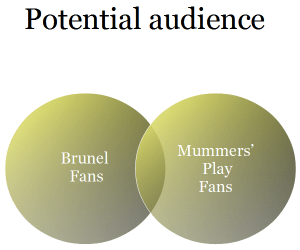
Brunel_audienceTurning this around, it was also apparent that this play could potentially attract two audiences; an audience of Brunel fans, and audience of Mummers’ Play fans.

To be honest, if I wanted to write and perform in a stand-alone piece of Brunel-themed street theatre which wasn’t within the mummers’ play tradition I probably would have found it a rather more complicated process. It was a useful way to introduce and establish the project in just a few words, both to Rag Morris and to the venues and other organisations that were to help with the staging of the production.

This mummers’ play, in common with many other such plays, was designed to be performed at a specific moment in space and time. So let’s look into where and when the play was first performed.

When?

Isambard Kingdom Brunel lived from 1806 to 1859. He died at the age of 53 after a stroke brought on by health problems, which would have been exacerbated by stress and his habit of smoking copious numbers of fine cigars every day.

Now my script was developed a couple of years after the Brunel 200 celebrations, so it was too late for that, but there was an opportunity to coincide with the 150th anniversary of Brunel’s death, which would fall on the 15th of September 2009.

The date also offered an opportunity to collaborate with another event for the historically inclined; Bristol’s Doors Open Day, which fell on the 12th of September that year. We wanted to take the play out to the locations most closely associated with Brunel’s story in Bristol, and many of these were either open especially for Doors Open Day or were close to other such venues. So with the kind cooperation of the organisers, we were heavily promoted in the Doors Open Day programme for that year.

Where?

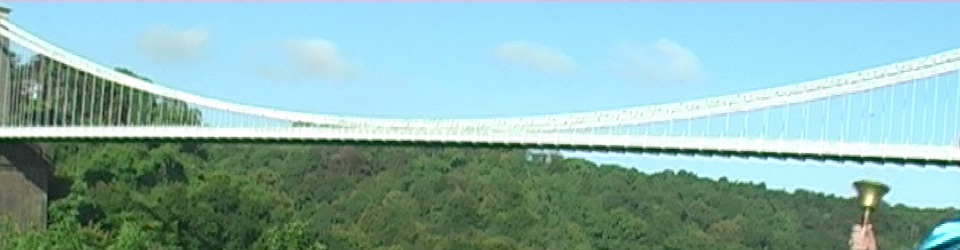
I made a map for our programme leaflet to show some Brunel-related sites in Bristol. The venues we took the play to included the Clifton Suspension Bridge, the Underfall Yard, the ss Great Britain, Queen Square and the Temple Meads passenger shed – Brunel’s old railway terminus.

Brunel Tour Map

One further performance was scheduled for the evening of the 15th of September next to the Explore-At-Bristol science centre where I was working, which was followed by a free Science Café discussion entitled, “When Engineers were Heroes”. This took place on the actual 150th Anniversary of Brunel’s death; and was, as far as I know, the only significant cultural event to mark this occasion.

We’ve now performed the play at various venues in Bristol, including the M-Shed, near the site of the dockyard where the Great Western Steamship was built, where we performed in April 2011 before heading to the Colston Hall.

What to wear?

As part of the development of the performance, we had to decide what the characters had to wear.

I’ve heard people say that Brunel’s top hat and tailcoat costume was unusual; that he wore a taller hat than everyone else because he was worried about his diminutive stature.

But the evidence clearly shows that this was not the case; your well-dressed man about town would often wear something of this kind. In contemporary photographs taken when Brunel attended the disastrous launch of his Leviathan steamship, he’s surrounded by men all wearing long coats and tall hats. So the characters on our play all wear the same basic outfit to replicate this look. This is similar to what the Doctor wears in many mummers’ plays, which makes a lot of sense, as the tradition of performing mummers’ plays was being established around this period and this is what many professional men would have worn at the time.

As Brunel ended his career while photography was still in its infancy, there are only around a half dozen photographs of him, and they are all fascinating and brilliant.

So that was how we appeared on our first public performance, at 10am on Saturday 12 September 2009, at the Clifton Suspension Bridge Lookout point. And I think we approximated the look of those old photos rather well. We all wear essentially the same costume, with just a few props – a taller hat, a cloak, painted faces – to distinguish between the different characters.

But why have the two bad guys got blue faces? There was, of course, a good reason for this. Brunel kept diaries and wrote letters throughout his life, many of which are now in the safekeeping of the Brunel Institute, run jointly by the ss Great Britain and the University of Bristol Library’s special collections archive.

One of these documents is Brunel’s secret diary, On one page, written in 1828, when he was just 22 years of age, a few months after the Thames Tunnel accident which caused the tunnel to be closed up, he uses various unusual phrases. When write about his hopes and dreams, he’d describe “castles in the air”; if things weren’t going so well for him, he’d sometimes say he was feeling “blue devilish”. At one point he says,

It makes me rather blue devilish to think of it and since I am very prone to build airy castles I will now build a few blue ones which I am afraid are likely to prove less airy and more real.

Now in those days these blue devils were a kind of common slang for depression and unhappiness; in later years the word “devils” would be dropped and people would simply say they had “the blues”. And Brunel suffered a lot from the blues and from self-doubt. Although his indefatigable spirit would enable him to put that to one side and dream up a new project that was even more groundbreaking than the last, even if it flew in the face of conventional wisdom, or even of common sense. As his colleague and friend Daniel Gooch said of him after his death; “great things are not done by those who sit down and count the cost of every thought and act.”

So perhaps Doctor Foster represents that indefatigable spirit; or at least, perhaps he had some of that spirit in his bag of medicine, mixed in with the laudanum. And he needed that because death hangs around the story of Brunel like a cloud, represented by Brunelzebub and his little black account book, recording the collateral damage which resulted from Brunel’s great construction projects, as many of the accounts of his life do, as if these engineering works were an equivalent to a military campaign.

I like to think that during his later life that when Brunel designed the mobile field hospitals used during the Crimean war, it was almost as an attempt to add some figures to the opposite side of the balance sheet, by saving a few lives to compensate for those which had been lost. And they certainly did save lives; the death rate in the Brunel-designed hospital, in Renkioi,  was 3%, compared to 42% in one of the hospitals it replaced, at Scutari.

But of course we didn’t need that counterbalance in our mummers’ play, because, as in countless other mummers’ plays, the Doctor is there to bring the dead man back to life again, to stick nine fingers up in the air at death and to say, today, in our world, on this stage, our hero does not die. And that is the story we attempted to tell; a story of challenges faced and met and conquered, a story of depression and death; of disaster and triumph; the story of that indefatigable spirit and of a remarkable man.

And at the end of the play, after the character of Old Leviathan arrives like an angel of doom to relate the tragic story of the Great Eastern steamship, Brunel lies on his deathbed, his life flashing before him, as if this performer and great engineer were imagining his own life story being acted out in the form of a mummers’ play; and so the play concludes, but Brunel Lives! And the seven characters become six dancers and one musician and together they perform a morris dance, and the spirit of his Great Leviathan can finally take the Ghost of Brunel on a voyage that never took place; a voyage to South Australia.

The beginning is nigh!

The Big Bang happened not just once, but twice, in the heart of the Mendips at Priddy Folk Festival on Sunday 13 July. The latest Rag Morris Mummers play took an unsuspecting audience right back to the dawn of time, when Old Father Time was still quite young and Old Mother Nature first wrote down all her laws.

A fiery ball of energy begat Mister Matter and Auntie Antimatter, who were just itching for a fight; requiring Professor Paul Dirac, Bristol’s first Nobel Prize-winning theoretical physicist, to explain his ground-breaking research, Doctor Barry O’Genesis to help solve one of the fundamental mysteries of the wonders of the universe, and Doctor Dark Matter, with his dark, dark medicine, to take Auntie Antimatter on a journey to the Dark Side. Constant Billy, however, just thought it was all far, far too silly.

The play was performed in the morning at the Eastwater Marquee and in the afternoon at the market field, to the delight and confusion of folk play enthusiasts and passers-by. One of them commented, “That was a bit like a mummers’ play”; and he wasn’t wrong.

The Big Bang can be thought to bookend Rag Morris’ sequence of historical, mythical and allegorical mummers’ plays; which now take in a potted history of nearly everything. We’ve paraded dozens of characters – including Vincent and Goram, Saint George, Robin Hood, Richard the Lionheart,  Isambard Kingdom Brunel, Queen Victoria and Prince Albert – in a flexible and adaptable format that almost always features a fight to the death and a Doctor with a little drop of tip-tap. Nevertheless there remain vast untapped tracts of tempting historical fact and fiction that remain unmummered, so watch this space for any hints of the the first inkling of what the next effort might concern.

If you could suggest any likely venues, festivals, physics conferences or quantum theory seminars where a performance of our Big Bang mummers play might be appreciated, please contact me or email bag@ragmorris.com.

No universes were created or destroyed during the production of our play.

The Big Bang

We are now rehearsing the next Rag Morris Mummers’ play, what I have wrote, entitled “The Big Bang”, which we are due to première at the Priddy Folk Festival on Sunday July 13th. We’re continuing our tradition of featuring local heroes from Bristol, following earlier mummers’ plays featuring both Vincent and Goram, and Isambard Kingdom Brunel. Our band of mummers are members of Rag Morris, a Morris Dance side that is also a University of Bristol Student’s Union Society. We include current and former University of Bristol students and postgraduates in the cast of this brand new play, which has in fact been inspired by one of the University’s greatest alumni. So watch out for Little Paul Dirac delivering a lecture about particle physics, a fight between Mister Matter and Auntie Anti-Matter, and Doctor Barry O’Genesis who arrives to save the day. In our view there is very little in life that cannot be improved by the addition of a morris dance; we hope to astound, educate and entertain in equal measure.

In Comes I, Little Paul Dirac, with all my formulae on my back

Paul Dirac was born in Bristol in 1902, and graduated from Bristol University twice, with a BSc in Electrical Engineering and a BA in Mathematics. He won a scholarship to study for a PhD in Cambridge where he carried out the work that earned him his reputation as a theoretical physicist of the highest order – describing an electron in a mathematically elegant equation that was compatible with both quantum physics and special relativity. The solution to this equation predicted the existence of a then-unknown atomic particle that was named the anti-electron, or positron, which was discovered experimentally a few years later and earned Dirac a Nobel Prize “for the discovery of new productive forms of atomic theory”. He was Britain’s answer to Einstein, but it has to be said, that he’s considerably less well known; a balance we are attempting to redress in our own small way with our little mummers’ play.

The tale before you shall be told of how the universe begun

Mummers’ plays are often justifiably accused of making little or no sense; a good vantage point, perhaps from which to survey a realm of quantum theory that few people can claim to understand. By using a format that is itself an invented pastiche of medieval mystery plays we attempt to shed a little light on a new creation mythology inspired by the unravelling of the sequence of events that took place in the first few seconds after the Universe was created. With limited success.

Come and have a go, if you think you’re hadron enough

At the heart of any traditional mummers’ play there is a conflict between two characters, one of whom falls and then rises again with the assistance of a mysterious doctor. In our new play the protagonists represent the symmetrical and opposite fundamental particles of matter and anti-matter. An equal amount of both was created in the seconds following the big bang and, all things continuing to be equal, all of this should have vanished; the matter and anti-matter cancelling each other out in a metaphorical puff of smoke, or a more literal burst of high energy gamma radiation photons. The fact that enough matter remained to form our present universe is a mystery that has stumped clever physicists for decades. This mystery may finally be solved if you are lucky enough to catch a performance of the latest Rag Morris Mummers’ play, “The Big Bang”.

Hatter and anti-hatter

Hatter and anti-hatter


A short history of mummers’ plays

In December 2011 Rag Morris Mummers performed a mummers’ play at an event in Henleaze, after which I gave a short talk about the history of mummers’ plays. The time has come for that talk to escape from obscurity in a dusty corner of a hard drive, and for it to get another airing.

Rag Morris Mummers had just performed an interpretation of a traditional mummers play. The script for this play had been recorded in the village of Alveston, which lies to the North-east of Bristol and to the South-west of Thornbury, where it had last been performed around 100 years ago; at least, that was, until the previous Saturday afternoon when we gave it our best shot in the Cross Hands Pub.

And around 100 years ago the mummers of Alveston would not have been alone. Similar groups of men would have been found performing their plays around Bristol, in places like Shirehampton and Kingswood; all around Gloucestershire and Somerset, and in fact in almost every county of England except East Anglia. You’ll have found Galoshins plays in Scotland, plays in Ireland where St Patrick was the hero and St George the villain, and plays like this were found in far flung corners of the world; mummers were renowned troublemakers in parts of Newfoundland, and in  Caribbean islands such as St Kitts & Nevis, mummers plays have mixed in with African traditions to produce some quite spectacular hybrid performances.

So the question remains, what were they all doing?

The performances of plays like these were an annual tradition, which formed part of the cycle of the years activities in many villages and towns, which might include events and rituals such as wassailing, May day celebrations, harvest festivals and Hallowe’en, as well as the religious festivals and holidays which they sometimes coincided with.

Folk plays were often performed by groups of men who called themselves mummers, though in different parts of the country you might find groups of soul cakers, Christmas Boys, plough jags or tipteerers; and the plays tended to be performed in the winter, normally in the weeks before Christmas, or between Boxing Day and twelfth night; although some traditions had their seasonal variations; the soul cakers of Cheshire perform around hallowe’en; in Lancashire the Pace Egg plays will appear around Eastertime.

The performers were often working class labourers who wanted to supplement their income over Christmastime to spend on a few treats for the family – shoes for the children, that kind of thing – or just to spend on a few drinks, and the chance of a morsel of roast beef, plum pudding or mince pie.  This financial aspect was often high on the agenda; in some cases it was a kind of ritualised begging or busking; it bears comparison with collecting a penny for the Guy on Bonfire night; singing of Christmas Carols door to door, or a tradition of singing around the houses for Hallowe’en, known in some parts of the country as guising or souling. This tradition has crossed the Atlantic and returned to us as Trick or Treating, which doesn’t involve any kind of a performance, which I always think of as a missed opportunity. It may have been that the performance of a Mummers’ play developed as an alternative to the singing of traditional songs, by similar groups of wandering performers.

In common with these traditions, Mumming was often performed inside people’s houses, the bigger the better; sometimes invited, and sometimes not. Perhaps the first thing that the master of the house or the Lord of the Manor would know about it would be a loud knock at the door, then in would come Father Christmas, welcome or welcome not; in costume, and often unrecognisable with a painted face, false beard, a hat covered in ribbons or paper tatters, sometimes completely obscuring his face, asking for “a room, a room to brave gallants all, pray give me room to rhyme!
I am come to show activity this merry Christmas time!” He’d then welcome in the rest of the cast, which could include St George or King George, Bold Slasher or the Turkish Knight, The Doctor, Beelzebub, Little Johnny Jack and so forth.

The performance could be between around 5 and 20 minutes long – the advantage of the shorter performance is that you could fit more houses or pubs in to the day or evening, and make more money; the mummers of Kingswood were known to run between venues; some mummers would spend all day on foot and travel 20 or 30 miles before they’d finish.

So where did this obscure idea originate? Nobody really knows, but it’s probably no more than around 300 years old, there isn’t any evidence for anything of a pre-historic or pagan origin. Influences in the form of the play can be traced in a variety of 18th Century performance styles; from Commedia del’ Arte to Pantomime; which in those days tended to draw on classical stories and Greek myths, featuring characters such as Harlequin and Doctor Faustus, Perseus and Andromeda; as well as travelling shows, including Medicine Shows with Quack Doctors trying to sell their wares, and street performers who often performed from the back of horse-drawn carts and in fairground booths.

An actor called John Edwin recorded in his memoir a variegated street performance which he claimed to have seen in Bristol in 1770; following a dialogue-free re-enactment of the Seige of Troy, depicted as a boxing match between Hector and Achilles which finished with Hector being knocked to the ground by a straight-forward blow there appear the following six lines of dialogue:

O’DRISCOL

A doctor, a doctor, ten pound for a doctor!

{Enter Physician}

PHYSICIAN

Here am I!

O’DRISCOL

What can you cure?

PHYSICIAN

The cramp, the gout, the pain within and the pain without!

O’DRISCOL

O boderation to your nonsense – can you bring a dead man to life again?

PHYSICIAN

Oh marry, that I can – take a little of my tip-tap, put it on your nip-nap, now rise up slasher and fight again.

These lines of dialogue represent one of the earliest occurrences in print of what would become the standard introduction for the doctor in a mummers play; the vast majority of mummers’ plays include a fight between two of the characters, and a doctor arriving to revive a dead or wounded man with some kind of pill or potion.

In fact these plays are often categorised as hero-combat-doctor plays.  The characters in the play would vary from place to place, region to region and sometimes year to year; if you look at the archive of original scripts you can find over 700 character names. The figure of King George is quite prominent in some of the early plays, which as they were being performed in the Georgian era would suggest that they were attempting to be topical, many of the lines associated with King George would be given to Saint George in other scripts. Some plays would feature Robin Hood; Rag Morris Mummers performed a script earlier in 2011 based on Robin Hood scripts recorded in villages in Gloucestershire and Oxfordshire; these scripts were obviously based on a ballad first recorded in 1663 featuring Robin Hood and the Bold Tanner, so it’s good to know that the writers of the original scripts were happy to do a bit of copying and pasting. And once the plays were starting to get established the scripts would be printed and reproduced, in chapbooks and pamphlets, as well as in novels and other books; the scripts would get read, performed, forgotten, misremembered, adapted and regurgitated across villages and towns so that eventually each group of mummers would have a script which they considered to be their own.

So the heyday of mummers plays performances in their original form was really the middle of the 19th century; by the early part of the 20th century it was starting to die out, and the final blow came with the first world war, when many of the men who took part in the plays were sent off to the front, and those who did return may not have had the inclination to resuscitate the play without the participation of their fallen comrades, and the whole tradition may not have fitted in to the brave new post-war world they suddenly found themselves in, where everything had changed.

In England today there are only a half dozen groups who can claim a continuous history going back before the Second World War; including the Paper Boys from Marshfield in Gloucestershire.

So what we have today can be thought of as a modern interpretation of a kind of performance that is both a historic tradition and a living tradition; but in most cases is performed by people from an utterly different background from those who would have performed such plays a hundred and fifty years ago; which now might include folk revivalists, morris dancers, street performers, schools and local drama groups as well as people who happen to live in places where a historical Mumming tradition is being nurtured and allowed to thrive; and those different kinds of performers might have all sorts of different reasons for wanting to put on a mummers play.

To generalise, you might find two contrasting views; with some degree of overlap; those who might wish to recreate the same kind of performance that you might have found a couple of hundred years ago, keeping to the same script, sometimes with the same people playing the same characters in the same locations on the same day year after year and even handing the character down from father to son; and those who might want to be a bit more flexible – ad-libbing, adding extra lines of dialogue to make it topical, gradually modifying the script, or even writing new plays which fit within the generic Mumming style. There is room for all these options within the living tradition, and I think that practitioners and aficionados of all kinds of plays have a lot of respect for the variety and quality which can be found in the way different groups across the country perform plays in their own unique style.

Rag Morris have been based at the University of Bristol since the group was founded in 1981 and have been performing traditional and non-traditional mummers’ plays sporadically throughout the last 30 years,

In 1993 there was a large scale production held at Blaise Castle, with a script by Marc Vyvyan-Jones help from Roland & Linda Clare, which told the story of the giants, Vincent and Goram who were responsible for carving out various geographical features around Bristol including the Avon Gorge. One of the characters in the play was called Brunel-zebub and he inspired me to write a new play entitled The Nine Lives of Isambard Kingdom Brunel, which we first performed in 2009 at various Brunel-related sites around Bristol.

At Christmas 2010 we performed at Bristol Zoo with a script I’d written entitled Prince Albert and the Lionheart, which, like the Robin Hood play, kept its source material fairly close to the surface. And in November 2011 we took our Brunel play to Bath, where we performed at the first International Mummers Unconvention, an event which saw a gathering of folk play performers, enthusiasts and researchers meet for a weekend of performances around the city, and a chance to chat about the past, present and future of the mummers play. And I’m sure you’ll agree, the past, present and future is looking decidedly up-beat.

FFI:

www.folkplay.info

www.mummersunconvention.com/

Must I command thee, Bold Robin Hood?

This summer, Rag Morris Mummers have been delighted to be invited to perform at two outdoor events; Priddy Folk Festival on 9th July and Westonbirt Arboretum Festival of the Tree on 29th August.

After a couple of made-up plays, we were keen to try our hands at a play with a more traditional origin. The celebration of trees led us to investigate the old plays with Robin Hood as a central character; which would have been performed in villages in Gloucestershire and Oxfordshire between 20 and 40 miles from Westonbirt. So, that performance will be almost on home turf.

We’ve taken a few different versions of the scripts, which diversified as they were carried across the land and changed through time; and combined them into some kind of incoherent whole taking lines and phrases from here and there to make a new-old play. Combine this with green hats and tights, and we believe we’ve got the makings of another modern classic.

The sheer range of characters who appear in different historical mummers’ plays is an indication of the flexibility of the “Quack Doctor” play format; which at the bare minimum, usually features 2 characters who end up in mortal combat, and the Doctor arriving to revive the one who falls over the hardest.

Robin Hood character names

Having already written a play (Prince Albert and the Lionheart) that used an existing poem as the basis of a mummers-style drama, it’s interesting to think that this is exactly what the people who put the original Robin Hood play script together did a hundred or more years ago. In this case it was the ballad of Robin Hood and the Tanner, which can be found in a collection dating back as far as 1663, but of course may be even older than that, and is possibly one of the earliest Robin Hood stories to have been told.

The ballad features the characters of Robin Hood, Little John and a Bold Tanner named Arthur-a-Bland (no relation to the remake of the Dudley Moore classic), but doesn’t include Maid Marion, or even any more of the Merry Men. The play also features the usual cast of misfits and rogues who turn up at the end, with no relation to the plot.

The original play script also liberally mucks about with the lines of the ballad, rewriting them, corrupting them, and assigning them to different characters. It may be the case that it was never properly written down and was misremembered from one year to the next – that’s how these plays tended to evolve. We’ve put some of the lines from the ballad back into the play to make it into even more of a hybrid. In the original story it’s Robin Hood and Arthur-a-Bland who try and tan each other’s hides; but in the mummers’ plays it tends to be Arthur-a-Bland and Little John; and it’s fairly interchangeable which one of those two needs to be fixed by the Doctor. You’ll just have to find out who does what to whom in the Rag Morris version by watching the play.

With thanks to Master Mummers, who have an invaluable collection of old folk play scripts, and to Tony Hearn, for finding a couple more.

So what’s it all about, anyway?

I first joined Rag Morris in the mid 1990s, shortly after I graduated from Bristol University. At that time Rag regularly performed both traditional and unconventional self-penned mummers plays for special occasions in Bristol or even on tours abroad. These were often written or instigated by Rag Morris scribe Marc Vyvyan-Jones. One of his productions was a spectacular play about the legendary giants Vincent and Goram, who were allegedly fundamental to many of Bristol’s geographical features. When Marc moved away from Bristol, I suspect nobody else felt confident enough to take on the challenge of the larger-scale mummers productions, although we still always performed a play for ourselves every year for our mid-winter party.

And so it came to pass that for a scriptwriting challenge in 2008, which would lead to the revival of a new company of Rag Morris Mummers, I started composing a new play about a local hero of engineering, Isambard Kingdom Brunel, whose story has become a central part of Bristol’s history, almost entering the realms of mythology, if it is possible to blur the boundaries a little. My choice of hero was in part inspired by a minor character from the Vincent and Goram play, named Brunelzebub; in the story it was Vincent himself who was responsible for carving out the Avon Gorge, where Brunel’s Clifton Suspension Bridge can now be admired.

I was aware that for the celebrations in 2005 surrounding the 200th anniversary of Brunel’s birth, an exhibition was hosted by the ss Great Britain, entitled ‘The 9 Lives of I.K. Brunel’, and this gave me the idea for the natural structure for the play. I undertook some considerable research, deciding that it ought to be crammed with historical accuracies, unlike most traditional mummers’ plays; and that the best way to present the tale would be as a bunch of storytellers each revealing a different aspect of Isambard’s personality. The number of genuinely life-threatening situations that Brunel actually placed himself in gave the semi-mythical character of Doctor Foster the opportunity to find a series of unlikely cures for our hero – although I was delighted to discover subsequently that Brunel was actually treated at one point by a Doctor Morris.

The 150th anniversary of Brunel’s death in September 2009 gave us a suitably apposite occasion to take our play out to various appropriate locations around the streets of Bristol, most of which were mentioned in the play. There had been vast numbers of events across the South-West coordinated by a special committee to commemorate Brunel’s 200th Birthday in 2006; however apart from the première of our play – which we initiated ourselves – there was very little else that marked the (sadder) anniversary in 2009. It felt like the time was right for the play and that history was conspiring to make it so. The performances were well received and Rag Morris Mummers were delighted to revive the play again for the inaugural Bristol Folk Festival in the Colston Hall in 2011.

As a storyteller, I like working out new ways of telling old stories, and these mummers’ plays offer an interesting platform to experiment with. They’re also hopefully fun to take part in and entertaining to watch – and if they aren’t then they always ought to be.

The concept of a “fix-it-up chappie” who turns up in the middle of a dramatic conflict, who often talks in riddles and has a connection to a mysterious or superior kind of knowledge; who is able to perform miraculous cures and fixes which lead to a resolution of the conflict or drama; appears time and again in all sorts of storytelling genres, from ancient myths and legends to religious texts, from hospital dramas to detective fiction. One wonders whether the creators of ‘Doctor Who’ ever appreciated the archetypal lineage of their central character. The quack doctor mummers’ plays often strip this central concept back to its bare bones. Without this character the play wouldn’t conclude with the happy ending that the audience expects the storyteller to provide.

A mummers’ play is part of the living tradition of storytelling and street performance. The form of this kind of play, with a quack doctor arriving to cure a fallen hero, is a fundamental plot device that seems to connect us to past generations of storytellers, while being brought into the living present with every performance. In fact every mummers’ play performance is an act of bringing a tradition back to life, which is a kind of meta-cure that most audiences, and some performers aren’t even aware of, but which is part of the implicit mystery that often seems to generates a certain kind of historical resonance; even if it’s just because the same play is always performed in the same way, year after year. And it even happens when a brand new mummers’ play is performed for the first time, to an unsuspecting public.

Hello, mummers!

Well now. I suspect it’s time to start a real blog-type thing, so here it is. I’ve written a couple of mummers’ plays which have been performed by Rag Morris Mummers over the last couple of years; another one, which hasn’t, yet; and I’m about to assemble a more traditional script for us to take out to various festivals and so forth over the summer. So this is the place to find out a bit more about the background to what’s been happening, and perhaps what might be included in the next bout – the pre-inclusion, if you like.

The first play was entitled “The Nine Lives of Isambard Kingdom Brunel”, which we did perform in Bristol first in 2009, and then again at the first Bristol Folk Festival, which took place at the end of April 2011; and the chances are we’ll be doing it again somewhere else later in the year. We were then invited to perform a play at Bristol Zoo last Christmastime, so in order to please the residents, I put together one called “Prince Albert and the Lionheart”, with apologies to Marriott Edgar, and Queen Victoria, who was not amused.

So I’ll put up a couple of features about that kind of thing, and then we’ll find out what happens next. Thanks for dropping by.

Gavin.