Rag Morris Mummers are currently in lock down and won’t be mumming for the foreseeable future, so to keep us all entertained during these days of isolation here’s a chance to see the full production of our mummers’ play, “The Nine Lives of Isambard Kingdom Brunel”.
This was a performance from 30th April 2011, filmed just outside the SS Great Britain, shortly before we took the play to the main stage of the Colston Hall for the inaugural Bristol Folk Festival.
We’ve just seen the anniversary of the birth of Marc Isambard Brunel on 25 April, and it’s a couple of weeks after Isambard Kingdom Brunel’s birthday on 9th April, so please consider this to be a fashionably late Birthday Present.
The Nineteen Lives
The play has been performed a number of times over the years since it was premiered in 2009.
The following list includes all public performances of the Brunel play, so far…
Date
Time
Location
Notes
12 September 2009
10:00
Zion Hill, near Clifton Suspension Bridge
World Premiere! Bristol Doors Open Day Bristol Poetry Festival
12 September 2009
11:30
Underfall Yard
As above
12 September 2009
12:30
SS Great Britain
As above
12 September 2009
14:30
Queen Square
As above
12 September 2009
15:30
Temple Meads Passenger Shed
As above
15 September 2009
19:30
Anchor Square, At-Bristol
150th Anniversary of Brunel’s death
29 September 2009
21:00
The Mansion House, Clifton Down, Bristol
Performance for the Lord Mayor!
3 July 2010
20:00
Great Western Morris 40th Anniversary, Christow.
“2 Lives” cutdown version
30 April 2011
11:30
SS Great Britain
Bristol Folk Festival warm-up
30 April 2011
12:30
M-Shed
As above
30 April 2011
14:00
Colston Hall, Main Stage
Bristol Folk Festival
24 September 2011
21:00
Woodhouse Park
Rag Morris 30th Anniverary Weekend
17 November 2011
21:15
Chapel Arts Centre, Bath
Bath Mummers Unconvention Mumming UnPlugged
19 November 2011
10.30
North Parade, Bath (Near the Huntsman pub)
Bath Mummers Unconvention
19 November 2011
11.10
Bath Abbey Churchyard (Near the West Door)
As above
19 November 2011
14.00
Old Bond St, Bath (North end)
As above
8 July 2018
11:00
Priddy Folk Festival, Eastwater Marquee
Nine Lives – 9th anniversary revival
21 July 2018
12:00
Brunel Square
Bristol Harbour Festival
21 July 2018
14:00
M-Shed
As above
Rag Morris Mummers meet Wallambard after performing at Bristol Harbour Festival 2018
Imagine a zip wire running through the Avon Gorge, under the Clifton Suspension Bridge, depositing a flock of happy flying punters on the Bedminster side of the river.
You may not have to imagine for much longer, for such a plan has already been proposed and supported by Bristol’s tourist authorities.
When this idea was first mooted in the Bristol Post recently, one of the questions posed was, “What would Brunel think?”
To contemplate his potential response, I’d recommend considering Brunel’s involvement in the 19th Century equivalent; his daring crossing of the gorge in a basket suspended beneath an iron bar that had been hauled the 900 yards across the gorge in the days before the laying of the foundation stone of the bridge in 1837. It’s an event that we marked in our Rag Morris Mummers Play, “The Nine Lives of Isambard Kingdom Brunel”, first performed in on Bristol Doors Open Day, September 12th 2009 to commemorate the 150th anniversary of the death of the great engineer.
To expand on our 90 seconds worth of exposition about the bridge from our half hour play, and to mark 5 years since that play first saw the light of day, 150 years since the Clifton Suspension Bridge was opened, and 155 years to the day since the death of Brunel, I thought it was time to write a bit more about how the bridge came to be built; about Brunel’s crossing on the Iron Bar and while I’m here, suggest a few things that the Clifton Zipsters might wish to look out for on their way back up to St Vincent’s Rock. I’ll admit that the page title is a bit misleading; but imagine, before the bridge was built, that the idea of crossing from one side of the gorge to the other by any means must have seemed as spectacular and as thrilling as today’s plans to install a zip wire.
The challenge is this! There’s a new competition…
Brunel’s design for the bridge was a response to a competition launched to find a solution to a problem – building a bridge across the Avon downstream from Bristol Bridge that would be high enough for tall ships to pass underneath, in a time before swing bridges and lift bridges were commonplace. The cliff faces of the Avon Gorge between Clifton and Leigh woods provided a natural foundation for the bridge. This was the site that an Alderman of Bristol, William Vick, had specified in 1753 when he left a legacy in his will that was intended to be used to build a Clifton Crossing, once the sum had accumulated to £10,000. By 1829 the Bridge Committee felt that sufficient funds were available and news of the competition caught the eye of one Isambard Kingdom Brunel, the 20 year old son of Sophia Kingdom and French Engineer Marc Isambard Brunel.
At that stage, the young IKB had been working as a resident engineer on his father’s Great Project – building a tunnel beneath the Thames between Rotherhithe and Wapping; the first underwater passenger tunnel ever attempted. However this dangerous work had resulted in a terrible flood on 12 January 1828, which left six men dead, Isambard severely injured, and work on the flooded tunnel suspended. It took six months for him to recuperate, time he spent in London, Plymouth and Bristol. While he was in the West Country he began to make the connections which would lead to him working in the Bristol Docks and submitting four proposals in response to the competition for designs for a Clifton Suspension Bridge. Each design crossed the Avon Gorge at a slightly different point, with spans of between 720 and 916 feet; two of which suspended the chains from the rock faces rather than from masonry towers.
The Bridge Committee appointed Thomas Telford, then the first President of the Institute of Civil Engineers, to judge the competition, bringing IKB into direct contact with one of the pillars of the engineering establishment. While Brunel’s proposals were imaginative and well received, when it came to actually building the bridge, Telford rejected all twenty two of the proposals submitted to the competition, including Brunel’s. Telford declared that the intended spans, dictated by the topology of the landscape, would be too wide for any suspension bridge proposed, due to the problem of lateral resistance to wind pressure. Telford’s own estimate of 600 feet as being the upper limit of the cast iron technology of the time, was remarkably similar to the span of his own Menai Suspension Bridge, completed in 1826. Instead Telford was asked to submit his own design, which reduced the span by the required distance by building a pair of massive stone pillars from the base of the Avon Gorge.
Telford Clifton Suspension Bridge plan – (Wikimedia)
Brunel’s response was cutting:
As the distance between the opposite rocks was considerably less than that which had always been considered as within the limits to which Suspension Bridges might be carried, the idea of going to the bottom of such a valley for the purpose of raising at great expense two intermediate supporters hardly occurred to me.
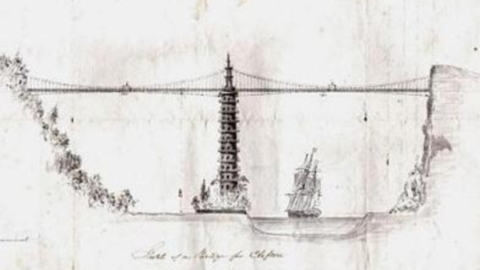
Such a response was in fact slightly disingenuous, as Marc Brunel had previously suggested to young Isambard that the gorge “could not be crossed in one” and had sent a sketch showing a single intermediate supporter raised from the bottom of the valley – in a “Chinese Pagoda” style, which appears to divert the course of the navigable river Avon to one side to accommodate it.
But why was Marc Brunel attempting to influence his young prodigy in the first place? In fact, it’s well documented that Marc Brunel was far more involved with the Clifton Bridge design than he is often given credit for. His sketch of a bridge with a support going to the bottom of the Avon Gorge was remarkably similar to one of a pair of suspension bridges at in the French island of Réunion, now known as Saint Denis, east of Madagascar, that had been designed and built by Marc Brunel in 1823; six years before the Clifton Bridge competition opened. The bridge over the Riviere du Mat also has an intermediate supporter in the centre of the bridge; compare for instance the arc of the additional suspension chains below the deck of the bridge, which were intended to give the bridge additional stability, and were a novel part of Marc’s design. Isambard, who supervised the assembly and testing of these bridges in England before they were shipped out to the Indian Ocean in kit form, also incorporated such inverted chains beneath the structures of all four of his original proposals.
Suspension Bridge on the Isle of Bourbon (Collection of David Denenberg)
Once Telford’s expensive solution was also rejected, in October 1830 the Clifton Bridge trustees reopened the competition for the bridge design, and Brunel, who had been continuously modifying and improving his own designs, was in a position to resubmit an application and was invited to do so, along with twelve other engineers. Following further consideration, Brunel and Telford were on the short-list of five; although Telford’s design still included the two “intermediate supporters” and was subsequently rejected.
Surprisingly, perhaps; one of Brunel’s four entries to the second competition also made use of a pair of massive pillars reaching down to the level of the river. Given Brunel’s earlier disparaging remarks, one wonders whether this was out of sheer pragmatism. If the judges might eventually decide that this was to be the principal that they wanted the design to follow, then Brunel was going to make sure that his proposal was the best of the bunch.
Brunel, he did enter – and won!
The four remaining engineers were allowed to continue working on their designs and Marc Brunel’s diary for early 1831 includes several months of work on the Clifton Bridge. When the final proposals were submitted, Isambard’s design was placed second; but he arranged an audience with the judges at Blaise Castle and through his not inconsiderable powers of persuasion, was able to resubmit his designs to address the engineering deficiencies that the judges had considered; an opportunity not afforded to the three other engineers. Isambard Kingdom Brunel was appointed as engineer to the Clifton Suspension Bridge on the 19th of March 1831, less than a month before his 25th birthday.
Even then, until the end of June, Marc Brunel was still busy working on the designs for Isambard’s bridge; and yet he was happy for the work to be credited to his son; perhaps for reasons of paternal altruism. Isambard’s appointment was made with the full knowledge that his more experienced father was known to be working on the designs; there was a safe pair of hands behind the inexperienced, yet talented, young engineer.
It could be said that Isambard Kingdom Brunel was Marc Brunel’s greatest engineering legacy; and that 150 years later, perhaps Isambard Kingdom Brunel as an individual or “brand” is greater than the sum of his engineering achievements. There are certainly other engineers whose works were more profitable, more numerous and more successful from an engineering point of view but the legacy of Isambard the Great Engineer, innovator, self publicist and showman has given his diminutive stature a longer shadow that many of his contemporaries.
To prove it would work, he traversed the route early
Before the foundation stone was laid amid pomp and ceremony on Saturday 27 August 1836 it was decided that the best way of transferring building materials from one side of the gorge to the other would be to install an iron bar across the gorge with a system for winching stuff across in a basket. The bar was 1000 feet long, 1½ inches wide and was welded together on the Leigh Woods side. Once it was assembled, on 23 August a ship’s mooring rope or hawser was passed across the gorge and the bar was carefully pulled across by winding this rope up with a capstan. However, just as it was about to be fixed to the rocks on the Clifton side, the hawser broke and the bar fell into the Avon Gorge. When the bar was hauled back up again the bar it somewhat the worse for wear.
This incident is beautifully described in “The Literary Gazette, and Journal of the Belles Lettres, Arts, Sciences, &c” 1836 edition. The British Association held their Sixth meeting in Bristol in August 1836 and it is no coincidence that Brunel chose to organise the ceremony of the laying of the foundation stone when some of the greatest natural philosophers of the day happened to be in town. In consequence, some of the events surrounding the ceremony have been recorded in this fascinating document.
In the course of the forenoon the iron rod, stretched across the Avon for the ceremony of Saturday morning, when the first stone of the suspension bridge is to be laid, was precipitated from its airy height in consequence of the breaking of a rope on the Clifton shore. One man only was slightly hurt, but the iron was embedded above five feet deep in the bed of the river. Its appearance, when fished up again, was very curious, being not only crusted with mud, but bent into all the forms of the channel into which it had been precipitated. Its curves and contortions, when once more elevated to its position, which was ably accomplished by the engineer (Brunel junior) before Thursday morning made it a more picturesque object than it was before; and thousands visited the spot which had become additionally interesting from the accident.
The breaking of the iron rod over the Avon created a strong sensation; and Mr Brunel approved himself worthy of his parentage, by the skill and exertion with which he fished it up and replaced it in time for the ceremony of Saturday morning.
The 27th August saw the grand ceremony for the laying of the foundation stone which was followed by a breakfast at the Gloucester Hotel, at which “The reception of the elder Brunel who arrived during the repast must have been particularly grateful to his feelings”. This was followed by a somewhat more notorious incident:
On the evening of this day, Messrs Laxton and Tait, two young engineers, we believe employed on the bridge, got into a basket-car and were drawn across the rod. Some obstacle occurred about midway, and the rope by which they were being pulled across, was obliged be loosened; and this at a time when the Benledi steamer was passing below. Her mast caught the line and had it not been cut with great presence of mind, in all probability a fatal catastrophe would have attended this adventurous attempt. As it was the oscillation of the rod with the suspended car was appalling, and the terror of the spectators was scarcely appeased when they saw the parties drawn back in safety to the shore.
It is curious that any suggestion of Brunel himself having a similar accident is not reported in this journal. The Bristol Mirror newspaper, however, reported the above story with some slightly different details; the basket contained one man, and named the Killarney as being the steamer involved. It then went on to say that that Brunel had a similar incident later in the same day where the basket stuck fast on the “kink” of the bar; whereupon
Mr Brunel endeavoured by swinging it to and fro to release the car but being unable to do so, this intrepid gentleman mounted the car, climbed the ropes and released the car when swinging over this tremendous chasm.
A. Vaughan in his excellent biography of Brunel, “Engineering Knight Errant” suggests that the above story may well be hearsay and somewhat unreliable. Perhaps the Bristol Mirror’s story pertaining to Brunel was a fabrication based on the event related above. In any case, it may well have been the start of the separation of the fact and the fiction in the history of Brunel; adding a dash of heroic mythology to the story of the Great Engineer.
The base of the Clifton Abutment (Photo: Gavin Skinner)
The base of the Leigh Woods Abutment showing the anchor point for the Iron Bar. (Photo: Gavin Skinner)
It is better documented that the bar was replaced during September and on the 27th of that month Brunel travelled in the basket across the gorge “with the greatest of ease”, three times; on each occasion with a different companion. Many years later in 1854, according to L.T. C. Rolt’s biography of Brunel, when work on the Bridge had ceased due to funding problems, the trustees collected £125 from people wishing to cross the gorge in a basket themselves. Rolt also suggests that the anchorage points for the bar are still visible near the bases of the abutments on both sides of the gorge. In fact, on the Leigh Woods side, the anchorage point is a square pillar that can be seen on the south side of the bridge approach. On the Clifton Side, the anchorage point is no longer visible but is marked by a pair of trees.
On 26 December 1835, the 29 year old Brunel wrote in his diary an end-of-year summary of his ongoing works, mostly railway-related, but including the famous quote:
Clifton Bridge – my first child, my darling, is actually going on – recommenced last Monday – Glorious!
And also a remark about his other suspension Bridge.
Suspension Bridge across the Thames (Hungerford foot-bridge) I have condescended to be engineer of this but I shan’t give myself too much trouble about it. If done it will add to my stock of irons.
However, his optimism was short-lived. The Hungerford bridge at Charing Cross would turn out the be the only suspension bridge to his design that he would live to see completed.
Incomplete in his lifetime
As with many of Brunel’s projects, the Clifton Bridge was not immune to financial considerations. The budget set aside for the bridge was never enough to complete it and despite efforts at additional fundraising the project stalled soon after 1840.The abutments, piers and towers on both sides of the bridge were mostly completed but bridge itself remained unbuilt and the suspension chains, although delivered by the Copperhouse foundry of Hayle, were surplus to requirements. The abutments became a popular venue for picnics and other, perhaps less wholesome, activities, and there was some discussion about whether to remove the unfinished construction work to return the gorge to its natural state.
With the bridge works on the back burner, over the course of his career Brunel was busy with a hundred other projects; including the Great Western Railway and various branch lines as well as railways in Ireland, Italy and India; his three Great Steamships; supervising the design and construction of the Great Exhibition and designing a portable field hospital used during the Crimean War.
In one of these projects he returned to the Avon Gorge with a proposal to build a railway down the western bank. The Portbury Pier and Railway company obtained parliamentary permission to build a railway line in 1846 to lead to a floating pier at Portbury; an early attempt to encourage shipping away from Bristol docks, which had the disadvantage of being situated some miles up the winding, tidal river Avon. As engineer to this company, Brunel proposed that the railway should use the Atmospheric Principal. At this point Brunel’s atmospheric railway in South Devon was under construction but not quite operational. If the Portbury line had been completed as planned, it may well have been a useful, less high profile, testing ground for this innovative system – which in South Devon generated the fastest speeds of any railway yet built. In the end, however, the atmospheric railway failed due to various technical and financial challenges, including problems with frost and rats; and Brunel’s Portbury line was shelved when the fundraising failed. A new company was formed some years later to build a railway to Portbury and Portishead, which received parliamentary approval in June 1863 and opened less than four years later in April 1867. Note that the current plan to rebuild the railway to Portishead always involves a perpetual five year wait.
Brunel’s final great bridge – the Royal Albert Bridge that carries the Great Western Railway across the Tamar from Plymouth to Saltash, was an extravagant yet elegant and uncharacteristically economically viable engineering solution to the problem of crossing the waterway. The design of the bridge includes two vast spans formed of lenticular, or lens-shaped trusses; the tops of the trusses being formed from heavy iron tube, the bottom of the trusses formed from a pair of chains. For these, Brunel bought the unused chains from the Clifton Bridge Trustees and had some more links made up at the Copperhouse foundry.
At the time that the bridge was opened in April 1859 by Prince Albert, Brunel was returning from a trip to Egypt where he had hoped the atmosphere would be beneficial to his health. The following month he was taken to see the Tamar bridge but by this time his health was so poor that he had to lie down on a couch while a locomotive pulled his carriage slowly across. Years of smoking, working long hours and suffering from accidents of various kinds were taking their toll.
A few months later, as his leviathan steamship, the SS Great Eastern, designed by Brunel and built by John Scott Russell, was being prepared for her maiden voyage, Brunel suffered from a heart attack on board and was taken back to his London residence to recuperate. He never recovered and died of a stroke on 15th September 1859.
Finished by friends, as a fitting tribute
Following his death, there was a posthumous proposal to complete Brunel’s vision for a Clifton Suspension Bridge as a memorial to the engineer. Foremost among those in favour of this scheme was John Hawkshaw; a leading light in the Institute of Civil Engineers, and distinguished engineer William Henry Barlow, who who were to become engineers to a new Clifton Suspension Bridge Company, with many other leading engineers acting as trustees. Hawkshaw was at that time planning the construction of a new London station at Charing Cross to be reached by a railway bridge across the Thames. This work would involve the dismantling of the Hungerford Bridge that Brunel himself had designed; and Hawkshaw realised that the new Clifton Bridge Company could be sold the suspension chains from that bridge while maximising the scrap value for the London Bridge and Charing Cross Railway.
The bridge company quickly found that financial support was forthcoming to find approximately £35,000 for the completion of the bridge. There was some concern among former bridge trustees and some Bristolians that the project was being managed and funded by Londoners, but a compromise was reached. A parliamentary “Act for erecting a Suspension Bridge from Clifton in the City and County of Bristol to the Parish of Long Ashton in the County of Somerset” became law on the 28th June 1861. Hawkshaw and Barlow re-engineered the design for the bridge to bring it up-to-date with current engineering principles, and also reduce costs by removing some of Brunel’s embellishments. The height of the piers was increased from 230 feet to 245 feet above the level of the river; the bridge deck was reduced from 32 feet to 30 feet in width. In many ways it is a bridge that is sited at Brunel’s original site and has a similar outline to the bridge that the Brunels – both Marc and Isambard – designed but on closer inspection holds few of the details that I.K.B himself may have planned to include.
The bridge was opened to foot passengers on 9th December 1864 with all the pomp and ceremony that Brunel himself would have appreciated; and there were beer and sandwiches at the Victoria Rooms for the workers. Conspicuous by their absence from any of these celebrations were I. K. Brunel’s sons; Isambard and Henry, who felt that not enough had been done to recognise the part their father had played in the project. They considered that Hawkshaw and Barlow had taken all the credit; despite the whole enterprise being a memorial to their esteemed father.
In future years both John Hawkshaw and Henry Marc Brunel would leave their legacy on the River Thames in ambitious projects that both Isambard and Marc Brunel would have been proud of. Hawkshaw was engineer to the East London Railway Company, which in 1865 took over Marc Brunel’s Rotherhithe to Wapping foot passenger tunnel, eventually using it to carry a railway line from New Cross to Shoreditch; now part of the London Overground network. If you’re in the area, do visit the splendid Brunel Museum at Rotherhithe. And Henry Marc Brunel, who learned engineering skills as a pupil of Hawkshaw became structural engineer to another Hawkshaw pupil, John Wolfe Barry, when he was chief engineer of Tower Bridge in London; which, like the Clifton Suspension Bridge, was an elegant 19th Century solution to the problem of designing the furthest downstream bridge on a major waterway that would allow tall ships to pass underneath.
The Clifton Zip Wire
The idea of a zip wire from the Clifton Bridge to Bedminster creates a bit of a problem – where would the wire end up? I would expect to be given the same constraints that Brunel was under, to allow safe passage for a tall ship to travel under the wire – with clearance of around 30 metres at the exit from the Cumberland basin, around 600 metres away from the bridge. Starting at the Clifton Observatory at around 90 metres above the high water mark, the zip wire would need to be at least 900 metres long, by my rough reckoning. To avoid the “Brunel Way” flyover, the wire would have to end up in Greville Smyth Park, or possibly on some corner of the Bedminster Cricket club. And I’m not sure if they’ve been asked yet.
So, what would the little blue daredevils have to look at on their long walk back to Clifton? I present three quite interesting structures of architectural and engineering merit that could be investigated.
1) The Ashton Avenue Bridge
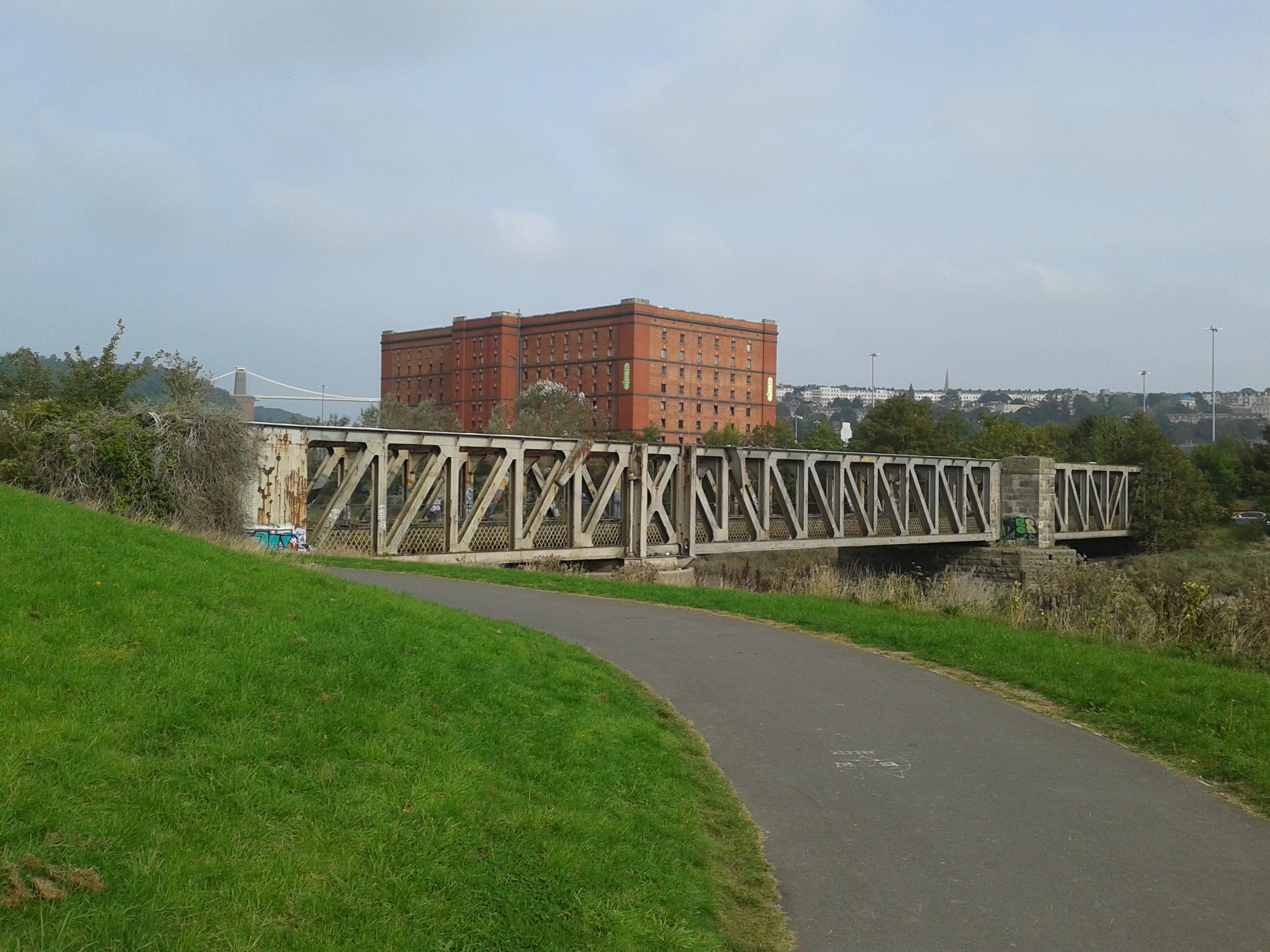
The Ashton Avenue Bridge (Photo: Gavin Skinner)
This was once a swing bridge at the entrance to the New Cut, which carried the Bristol harbour railway on the lower deck and road traffic on the upper deck. Long since replaced by the Brunel Way flyover, the upper deck has been removed and the lower deck is a footpath and cycleway now used as part of the national cycle network.
Plans are afoot to incorporate the bridge in the controversial Bristol MetroBus system. According to TravelWest, the plan is to “restore the Victorian Bridge and return it to its original role as a public transport corridor.”
I for one would love to see it restored to its Victorian double decker heyday with a separate roadway for the buses and cycleway underneath; it would be particularly impressive to see it in operation as a swing bridge again; although I don’t suppose this is what the MetroBus People have in mind.
2) Brunel’s Other Bridge
Brunel’s Other Bridge (Photo: Gavin Skinner)
This structure, currently hidden away beneath the larger Plimsoll Bridge at the end of Cumberland basin (which leads on to Brunel Way) was a large wrought iron swivel bridge, which was designed by I.K.Brunel’s engineering practice and first became operational in 1849. Its iron tubular structure can be seen to foreshadow Brunel’s later railway bridge over the River Wye at Chepstow and the Prince Albert Bridge over the Tamar. Before the Clifton Bridge was completed, Brunel finally achieved his ambition of constructing the first bridge over the Avon upstream of the Severn estuary.
There’s a campaign by various local enthusiasts to restore and preserve this bridge for future generations, and they are doing a fantastic job.
3) The Clifton Rocks Railway
The Clifton Rocks Railway – Lower Station (Photo : Gavin Skinner)
This uneconomical funicular railway was built in a tunnel through the cliffs from the Avon Gorge Hotel, to Hotwells, first opened in 1893. The intention at the time was to offer connections from Clifton Village to the tramways into the city centre, the railway to Severn beach and steam ships from the Hotwells landing stage. After the widening of the Portway in 1922 – now the main A4 route between Bristol and Avonmouth – the Clifton Rocks Railway fell into decline and closed in 1934; although it was used by the BBC as a radio broadcasting studio during the second world war.
I would propose that the most exciting route back for out intrepid Clifton Zipsters would be up through the Clifton Rocks Railway tunnel. I know that it’s never going to be reopened as a railway but perhaps some kind of pulley system could be reintroduced?
In conclusion
I hope this has been a useful potted history of the Clifton Bridge; and the interconnected roles played by Marc and Isambard Brunel, John Hawkshaw and William Barlow; and how it fits into the surrounding natural and historical landscape. I look forward to taking my place in the queue for the the Clifton Zip Wire, whenever it gets built; or if not, alternatively I can hope that one day I shall have an opportunity of crossing the gorge in a small basket, suspended beneath a thin iron bar.
Five years ago, in September 2009, Rag Morris Mummers first performed a mummers play about the life of Isambard Kingdom Brunel. Two years later we took the play to the first Bath Mummers Unconvention, and I presented a talk about the play at the Mummers Symposium; the text from the talk is available in the Symposium Proceedings on the Folk Play research web site. Now that it’s five years since we started rehearsing our play, I thought it was time to add a version of that talk on my preinclusion blog, and at the same time include some video excerpts of our first performances.
You may have been lucky enough to see the play in Bristol in 2009, or at the 2011 Bristol Folk Festival where it was performed on stage at the Colston Hall. The play was performed at the 2011 Bath Mummers Unconvention, firstly at the UnPlugged concert on the opening night and then on the following Saturday when we took it out on to the streets of Bath.
I’m going to be looking into some of the questions I’ve been asking myself about the play since the inception of the project; and how the answers to those questions informed the development of the play, looking at aspects of the philosophy of the performance and the production.
Who?
Bristol’s Rag Morris used to have more of a tradition of performing self-penned plays, though the last major production had been 1993, a year before I started dancing regularly with Rag. This play about the legendary Bristolian giants, Vincent and Goram, had been penned by Marc Vyvan-Jones with help from Roland & Linda Clare.
These two giants had a test of strength to win the hand of the fair Princess Sabrina, and to prove his worth; Vincent carved out the Avon Gorge with a pickaxe. The script for this play included the character of Brunel-zebub, as the devil with the frying pan who was raising funds to build a bridge to span St Vincent’s Rocks.
So while I was thinking about writing a mummers’ play, and who should be in it; using the script of the Vincent and Goram play as a template for creating a local story about a Bristolian hero; I started thinking about Brunel-zebub and the man who had inspired the name of this character, and whether Isambard Kingdom Brunel himself could star in his own mummers’ play and return for a showdown with his inner demon.
But would Brunel make a suitable candidate for inclusion in a mummers’ play, which would attract an audience in Bristol? As I started thinking about the characteristics needed for our mummers’ play hero, and reading a few books about Brunel for research, he seemed to tick a lot of the boxes.
1) Was he a hero in the tradition of St George or Robin Hood?
Yes he was; he came from a class of men who have been referred to as “heroic engineers”, such as Thomas Telford or George and Robert Stephenson who personified the fight against the greatest technical challenges of the day. A contemporary editor of the Railway Times described him as an “Engineering Knight Errant”, and went on to say he was; “always on the lookout for magic caves to be penetrated and enchanted rivers to be crossed, never so happy as when engaged ‘regardless of cost’ in conquering some, to ordinary mortals, impossibility.” This was when Brunel was developing his atmospheric railway, so the writer wasn’t being entirely complimentary. But such a character seemed ideal for a mummers’ play.
2) A defining moment of any mummers’ play is a fight. Did our hero get into fights?
Yes he did. He was in Bristol during the Queen Square riots of 1831, he was sworn in as a special constable and arrested a looter. Twenty years later he instigated his own riot at Mickleton Tunnel, commanding an army of 3000 navvies in a dispute with a company of contractors who had failed to complete their work on time and on budget. He was also a risk-taker and rather accident-prone, and these accidents provided an opportunity for our Doctor character to revive him with his pills and potions.
3) Was he a local hero?
Brunel had a strong association with the City of Bristol, although he never had a permanent address there. Many of his major projects were connected with the city; his designs for the Clifton Suspension Bridge were first submitted at the age of 23; the original terminus for the Great Western Railway was in Bristol and two of his great steamships were built and launched into the Bristol Harbour.
4) Was he a popular and interesting character?
Brunel a fascinating and complex individual whose story encapsulates both the successes and failures of the Victorian age. In 2002 he was voted number 2 in the BBC’s poll of Greatest Britons, second only to Winston Churchill. And his name pops up all the time in the most unlikely places. In the summer of 2011, Bristol Zoo organised an Art Trail of model gorillas around the city, which were then auctioned off for charity. The gorilla that raised the most money was called Gorisambard; the final bid being more than twice as much as the nearest rival, a whopping £23,000. I’d suggest it was the most sought-after gorilla simply because of its connection with the city’s favourite local hero.
How?
So, Brunel ticked all four of these boxes, and having chosen the star of the show, I started to think about how to write the script. There were two clear choices; write a simple hero-combat play with Brunel as a character in name alone, with a few jokes about cigars and railways; or to build the play around one or two historical events from Isambard’s life.
Before this project began, I wasn’t quite as obsessed about Brunel as perhaps I am now. But as I read more and more, it became clearer to me that to do the story justice and to honour the man’s memory it would be better to stick to the historical fact than the hysterical fiction. Because with Brunel, the truth was often stranger than fiction; and because his story was so full of incident and intrigue, I wouldn’t structure the play around just one historical event; it would be based around nine.
In 2006, a series of cultural events and exhibitions to celebrate the bicentenary of Isambard’s birth was organised by the Bristol Cultural Development Partnership under the banner of Brunel 200. As part of this, the ss Great Britain hosted an exhibition at the nearby Maritime Centre entitled, “The 9 lives of I.K.Brunel”.
This exhibition looked at Brunel’s life and career by highlighting nine occasions when he was in mortal danger, from a flood in the Thames Tunnel he was helping his father, engineer Marc Brunel, to build; to a fall into the engine room of his first great steamship, the Great Western, following a fire. Incidents such as these occurred throughout his life; if you read any stories or books that mention Brunel even in passing, you’ll often find one of more of these events gets mentioned, almost as a defining moment, the disasters complementing the triumphs. Brunel’s life story has created a kind of historical mythology of its own; and it’s that mythology which we tried to capture in this play, by concentrating simply on these triumphs and disasters.
The nine lives structure lent itself perfectly to that of a mummers’ play, or rather nine short mummers’ plays, and that’s how the script developed; each with a brief introduction to set the scene, a challenge, incident or accident to provide the dramatic peak or turning point, represented by some visual gag or dramatic reconstruction, which would then be quickly resolved; where necessary with a little something from the Doctor’s bag to get the man back on his feet, all ready for the next disaster.
The character of Brunel was surrounded by a cast of six other characters, all loosely based on mummers’ play archetypes, who would be called upon to represent some aspect of his personality or an influence on the story. These included Brunelzebub, Bold Slasher, Little Johnny Jack, and Old Father Thames, who represents the rivers associated with Brunel’s projects, which he spent so much time bridging, tunnelling underneath or launching ships into; and Doctor Foster, down from Gloucester, who stands in for all the physicians who treated Brunel after his accidents and through his ill-heath; one of whom was actually called Doctor Morris.
What I wanted to do was to create a kind of performance that drew from the mummers’ play tradition, and was also a play about Brunel. So to visualise the relationship between these sets of ideas, I drew this venn diagram. What we ended up with was a hybrid of two plays – a mummers play biography – and finding out where and how these two parts intersected was the challenge of writing the script.
Turning this around, it was also apparent that this play could potentially attract two audiences; an audience of Brunel fans, and audience of Mummers’ Play fans.
To be honest, if I wanted to write and perform in a stand-alone piece of Brunel-themed street theatre which wasn’t within the mummers’ play tradition I probably would have found it a rather more complicated process. It was a useful way to introduce and establish the project in just a few words, both to Rag Morris and to the venues and other organisations that were to help with the staging of the production.
This mummers’ play, in common with many other such plays, was designed to be performed at a specific moment in space and time. So let’s look into where and when the play was first performed.
When?
Isambard Kingdom Brunel lived from 1806 to 1859. He died at the age of 53 after a stroke brought on by health problems, which would have been exacerbated by stress and his habit of smoking copious numbers of fine cigars every day.
Now my script was developed a couple of years after the Brunel 200 celebrations, so it was too late for that, but there was an opportunity to coincide with the 150th anniversary of Brunel’s death, which would fall on the 15th of September 2009.
The date also offered an opportunity to collaborate with another event for the historically inclined; Bristol’s Doors Open Day, which fell on the 12th of September that year. We wanted to take the play out to the locations most closely associated with Brunel’s story in Bristol, and many of these were either open especially for Doors Open Day or were close to other such venues. So with the kind cooperation of the organisers, we were heavily promoted in the Doors Open Day programme for that year.
Where?
I made a map for our programme leaflet to show some Brunel-related sites in Bristol. The venues we took the play to included the Clifton Suspension Bridge, the Underfall Yard, the ss Great Britain, Queen Square and the Temple Meads passenger shed – Brunel’s old railway terminus.
One further performance was scheduled for the evening of the 15th of September next to the Explore-At-Bristol science centre where I was working, which was followed by a free Science Café discussion entitled, “When Engineers were Heroes”. This took place on the actual 150th Anniversary of Brunel’s death; and was, as far as I know, the only significant cultural event to mark this occasion.
We’ve now performed the play at various venues in Bristol, including the M-Shed, near the site of the dockyard where the Great Western Steamship was built, where we performed in April 2011 before heading to the Colston Hall.
What to wear?
As part of the development of the performance, we had to decide what the characters had to wear.
I’ve heard people say that Brunel’s top hat and tailcoat costume was unusual; that he wore a taller hat than everyone else because he was worried about his diminutive stature.
But the evidence clearly shows that this was not the case; your well-dressed man about town would often wear something of this kind. In contemporary photographs taken when Brunel attended the disastrous launch of his Leviathan steamship, he’s surrounded by men all wearing long coats and tall hats. So the characters on our play all wear the same basic outfit to replicate this look. This is similar to what the Doctor wears in many mummers’ plays, which makes a lot of sense, as the tradition of performing mummers’ plays was being established around this period and this is what many professional men would have worn at the time.
As Brunel ended his career while photography was still in its infancy, there are only around a half dozen photographs of him, and they are all fascinating and brilliant.
So that was how we appeared on our first public performance, at 10am on Saturday 12 September 2009, at the Clifton Suspension Bridge Lookout point. And I think we approximated the look of those old photos rather well. We all wear essentially the same costume, with just a few props – a taller hat, a cloak, painted faces – to distinguish between the different characters.
But why have the two bad guys got blue faces? There was, of course, a good reason for this. Brunel kept diaries and wrote letters throughout his life, many of which are now in the safekeeping of the Brunel Institute, run jointly by the ss Great Britain and the University of Bristol Library’s special collections archive.
One of these documents is Brunel’s secret diary, On one page, written in 1828, when he was just 22 years of age, a few months after the Thames Tunnel accident which caused the tunnel to be closed up, he uses various unusual phrases. When write about his hopes and dreams, he’d describe “castles in the air”; if things weren’t going so well for him, he’d sometimes say he was feeling “blue devilish”. At one point he says,
It makes me rather blue devilish to think of it and since I am very prone to build airy castles I will now build a few blue ones which I am afraid are likely to prove less airy and more real.
Now in those days these blue devils were a kind of common slang for depression and unhappiness; in later years the word “devils” would be dropped and people would simply say they had “the blues”. And Brunel suffered a lot from the blues and from self-doubt. Although his indefatigable spirit would enable him to put that to one side and dream up a new project that was even more groundbreaking than the last, even if it flew in the face of conventional wisdom, or even of common sense. As his colleague and friend Daniel Gooch said of him after his death; “great things are not done by those who sit down and count the cost of every thought and act.”
So perhaps Doctor Foster represents that indefatigable spirit; or at least, perhaps he had some of that spirit in his bag of medicine, mixed in with the laudanum. And he needed that because death hangs around the story of Brunel like a cloud, represented by Brunelzebub and his little black account book, recording the collateral damage which resulted from Brunel’s great construction projects, as many of the accounts of his life do, as if these engineering works were an equivalent to a military campaign.
I like to think that during his later life that when Brunel designed the mobile field hospitals used during the Crimean war, it was almost as an attempt to add some figures to the opposite side of the balance sheet, by saving a few lives to compensate for those which had been lost. And they certainly did save lives; the death rate in the Brunel-designed hospital, in Renkioi, was 3%, compared to 42% in one of the hospitals it replaced, at Scutari.
But of course we didn’t need that counterbalance in our mummers’ play, because, as in countless other mummers’ plays, the Doctor is there to bring the dead man back to life again, to stick nine fingers up in the air at death and to say, today, in our world, on this stage, our hero does not die. And that is the story we attempted to tell; a story of challenges faced and met and conquered, a story of depression and death; of disaster and triumph; the story of that indefatigable spirit and of a remarkable man.
And at the end of the play, after the character of Old Leviathan arrives like an angel of doom to relate the tragic story of the Great Eastern steamship, Brunel lies on his deathbed, his life flashing before him, as if this performer and great engineer were imagining his own life story being acted out in the form of a mummers’ play; and so the play concludes, but Brunel Lives! And the seven characters become six dancers and one musician and together they perform a morris dance, and the spirit of his Great Leviathan can finally take the Ghost of Brunel on a voyage that never took place; a voyage to South Australia.
The Big Bang happened not just once, but twice, in the heart of the Mendips at Priddy Folk Festival on Sunday 13 July. The latest Rag Morris Mummers play took an unsuspecting audience right back to the dawn of time, when Old Father Time was still quite young and Old Mother Nature first wrote down all her laws.
A fiery ball of energy begat Mister Matter and Auntie Antimatter, who were just itching for a fight; requiring Professor Paul Dirac, Bristol’s first Nobel Prize-winning theoretical physicist, to explain his ground-breaking research, Doctor Barry O’Genesis to help solve one of the fundamental mysteries of the wonders of the universe, and Doctor Dark Matter, with his dark, dark medicine, to take Auntie Antimatter on a journey to the Dark Side. Constant Billy, however, just thought it was all far, far too silly.
The beginning is nigh!
Nature abhors a vacuum
I challenge thee to come and have a go, if you think you’re hadron enough
In comes I, Little Paul Dirac, with all my formulae on my back
Positive vs Negative
In comes I, Doctor Barry o’Genesis
In Come I, Doctor Dark Matter
On with the dance!
The play was performed in the morning at the Eastwater Marquee and in the afternoon at the market field, to the delight and confusion of folk play enthusiasts and passers-by. One of them commented, “That was a bit like a mummers’ play”; and he wasn’t wrong.
The Big Bang can be thought to bookend Rag Morris’ sequence of historical, mythical and allegorical mummers’ plays; which now take in a potted history of nearly everything. We’ve paraded dozens of characters – including Vincent and Goram, Saint George, Robin Hood, Richard the Lionheart, Isambard Kingdom Brunel, Queen Victoria and Prince Albert – in a flexible and adaptable format that almost always features a fight to the death and a Doctor with a little drop of tip-tap. Nevertheless there remain vast untapped tracts of tempting historical fact and fiction that remain unmummered, so watch this space for any hints of the the first inkling of what the next effort might concern.
If you could suggest any likely venues, festivals, physics conferences or quantum theory seminars where a performance of our Big Bang mummers play might be appreciated, please contact me or email bag@ragmorris.com.
Mummers Reunited
Sweep you all back to the past
Back in time
The Quantum Theory of the Electron
Is there a doctor to be found?
Come and have a go if you think you’re hadron enough
Dark, dark medicine
Bang!
No universes were created or destroyed during the production of our play.
We are now rehearsing the next Rag Morris Mummers’ play, what I have wrote, entitled “The Big Bang”, which we are due to première at the Priddy Folk Festival on Sunday July 13th. We’re continuing our tradition of featuring local heroes from Bristol, following earlier mummers’ plays featuring both Vincent and Goram, and Isambard Kingdom Brunel. Our band of mummers are members of Rag Morris, a Morris Dance side that is also a University of Bristol Student’s Union Society. We include current and former University of Bristol students and postgraduates in the cast of this brand new play, which has in fact been inspired by one of the University’s greatest alumni. So watch out for Little Paul Dirac delivering a lecture about particle physics, a fight between Mister Matter and Auntie Anti-Matter, and Doctor Barry O’Genesis who arrives to save the day. In our view there is very little in life that cannot be improved by the addition of a morris dance; we hope to astound, educate and entertain in equal measure.
In Comes I, Little Paul Dirac, with all my formulae on my back
Paul Dirac was born in Bristol in 1902, and graduated from Bristol University twice, with a BSc in Electrical Engineering and a BA in Mathematics. He won a scholarship to study for a PhD in Cambridge where he carried out the work that earned him his reputation as a theoretical physicist of the highest order – describing an electron in a mathematically elegant equation that was compatible with both quantum physics and special relativity. The solution to this equation predicted the existence of a then-unknown atomic particle that was named the anti-electron, or positron, which was discovered experimentally a few years later and earned Dirac a Nobel Prize “for the discovery of new productive forms of atomic theory”. He was Britain’s answer to Einstein, but it has to be said, that he’s considerably less well known; a balance we are attempting to redress in our own small way with our little mummers’ play.
The tale before you shall be told of how the universe begun
Mummers’ plays are often justifiably accused of making little or no sense; a good vantage point, perhaps from which to survey a realm of quantum theory that few people can claim to understand. By using a format that is itself an invented pastiche of medieval mystery plays we attempt to shed a little light on a new creation mythology inspired by the unravelling of the sequence of events that took place in the first few seconds after the Universe was created. With limited success.
Come and have a go, if you think you’re hadron enough
At the heart of any traditional mummers’ play there is a conflict between two characters, one of whom falls and then rises again with the assistance of a mysterious doctor. In our new play the protagonists represent the symmetrical and opposite fundamental particles of matter and anti-matter. An equal amount of both was created in the seconds following the big bang and, all things continuing to be equal, all of this should have vanished; the matter and anti-matter cancelling each other out in a metaphorical puff of smoke, or a more literal burst of high energy gamma radiation photons. The fact that enough matter remained to form our present universe is a mystery that has stumped clever physicists for decades. This mystery may finally be solved if you are lucky enough to catch a performance of the latest Rag Morris Mummers’ play, “The Big Bang”.






 What I wanted to do was to create a kind of performance that drew from the mummers’ play tradition, and was also a play about Brunel. So to visualise the relationship between these sets of ideas, I drew this venn diagram. What we ended up with was a hybrid of two plays – a mummers play biography – and finding out where and how these two parts intersected was the challenge of writing the script.
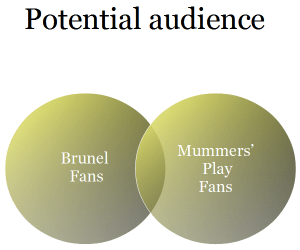 Turning this around, it was also apparent that this play could potentially attract two audiences; an audience of Brunel fans, and audience of Mummers’ Play fans.


 preinclusion